What Global Slowdown? Japan Inc. Is Roaring Ahead

U.S. corporate tax breaks lead to bonuses and stock buybacks. Japanese corporate tax breaks are tied to reinvestment in R&D, training employees, and purchasing equipment. Maybe the policy makers in our government can reconsider blanket tax cuts in the face of this “new” evidence (read: common sense).

What Global Slowdown? Japan Inc. Is Roaring Ahead
https://www.bloomberg.com/view/articles/2018-10-10/japan-s-companies-ramp-up-spending-after-tax-change

Unraveling a Tesla Mystery: Lots (and Lots) of Parked Cars – The New York Times

Apologies if this is a repeat.

Interesting article. Here is one quote that caught my eye:

“Over the summer, Tesla advertised online for technicians to repair vehicles coming off the assembly line, suggesting that a significant number needed rework.”

Pause. Repair vehicles coming off the assembly line? Why not fix the assembly line or product design that produces defective vehicles?

I wonder if Musk will complain about all of the public exposure of activities such as this. If so, how could he defend going public and having repeated rounds of seasoned offerings? How could one reconcile accepting public money (IPO, SEOs) but not accepting scrutiny from the public that provided the money?

The article notes that the next quarterly report will be scrutinized by the SEC. This could get more interesting…

-Dr. Moore

New York Times article:

https://www.nytimes.com/2018/10/01/business/tesla-cars-questions.html

Trader Who Ripped Off His Mom, Friends Gets 8 Years

To me this Is more a story about a mother’s love than a Ponzi scheme.

While his former friends and family wanted the maximum penalty his mom asked the judge for leniency towards her son – a son that ripped $50,000 off of her. God bless his mother.

-Dr. Moore

Trader Who Ripped Off His Mom, Friends Gets 8 Years
https://www.bloomberg.com/news/articles/2018-09-27/trader-who-ripped-off-mom-friends-in-n-y-suburb-gets-8-years

IQ-SIF: Inclusive & Quantitative Student Investment Fund Launched!

Greetings everyone,

The new Inclusive & Quantitative Student Investment Fund (IQ-SIF) is now live. Please visit the fund’s website, www.iq-sif.com, read what we are about, and submit your email to “follow” if so inclined. I would really appreciate your support.

The inaugural IQ-SIF meeting will occur this Monday, September 24, 2018, at 3:00 PM in LIB 2029. That meeting will give an overview of the fund’s goals, the path to attaining that goal, organization, and will have two guest speakers from the financial industry. The meeting announcement is included in this post.

Much thanks to all that have supported, are supporting, and will support this effort.

Regards,

-Dr. Moore

After Short-Lived Kaepernick Dip, Nike Hits an All-Time High

Nike executives are doing what they are supposed to: maximize shareholder wealth. Some would disagree with their decision, but as a shareholder I do not!

After Short-Lived Kaepernick Dip, Nike Hits an All-Time High
https://www.bloomberg.com/news/articles/2018-09-13/nike-erases-short-lived-kaepernick-dip-hits-all-time-high

Nike Orders Rose in Four-Day Period After Kaepernick Ad Debut

While discussing the goal of a company, maximize shareholders wealth, in FIN101 this week a student asked a thinly-veiled political question: “what are your thoughts on the Nike-Kaepernick deal.” I connected Nike’s decision to the goal just discussed: maximizing shareholder wealth. True, Nike is down a little bit, but time will tell if Nike’s calculations were correct.

Another point to consider, but not mentioned in the Bloomberg article, is the fact that Nike is a global company. As such, the opinions of a few Trump supporters or right wing folks in the United States may be meaningless compared to additional revenue generated outside the United States. In short, on a global scale, there may be just a few loud and irrelevant people burning Nike products (instead of giving them to homeless veterans or something) and billions of quiet people buying more Nike products in support.

-Dr. Moore

Nike Orders Rose in Four-Day Period After Kaepernick Ad Debut
https://www.bloomberg.com/news/articles/2018-09-07/nike-orders-rose-in-four-day-period-after-kaepernick-ad-debut

Apple, Oracle Dump Bonds and Create $300 Billion Hole in Market

As I read this article two things came to mind:

1. Does the exit of large tech companies from the short term corporate bond market add yet another factor driving yield curve inversion?

2. Did our policy makers consider what may follow when implementing the tax cuts earlier this year?

I know, I know, $306 billion brought back from overseas was supposed to produce jobs here in the U.S. but what really happened? The companies paid special dividends and repurchased stock (http://time.com/money/5267940/companies-spending-trump-tax-cuts-stock-buybacks/). They did not build factories.

This is an example of trickle-up economics. For who is harmed by tax cuts? Those who rely on public services that must be cut in order to pay for the tax cuts. Maybe the wealthy people who benefit from the special dividends, stock repurchases, and tax cuts will use the extra cash to buy Ford and Chevy cars Or maybe they will buy Mercedes and Ferrari.

Tax cut -> repatriate dollars -> stock buybacks and special dividends -> lack of funding for smaller corporations -> yield curve inversion-> recession.

Time will tell his this all plays out. I don’t know the future, but I am a bit concerned.

-Dr. Moore

Apple, Oracle Dump Bonds and Create $300 Billion Hole in Market
https://www.bloomberg.com/news/articles/2018-08-31/apple-oracle-dump-bonds-and-create-300-billion-hole-in-market

‘Peak Car’ and the End of an Industry

Wouldn’t it be ironic if we reach “peak car” (that is the turning point where individual car ownership declines as more and more people use scooters, Uber, etc.) just as Tesla figures out how to mass produce cars profitably? That would be a big bummer for Tesla shareholders – to own stock in a company finally able to mass produce cars just as the demand for those cars wanes.

Maybe Tesla has “mobility” plans.

-Dr. Moore

‘Peak Car’ and the End of an Industry
https://www.bloomberg.com/news/articles/2018-08-17/-peak-car-and-the-end-of-an-industry

Never Mind Tesla, BMW’s the Real Deal for a Buyout

Interesting opinion article that includes some basic facts: BMW is a profitable dividend-paying forward-looking and electric-car investing automobile company that makes millions of cars per year but with a lower market valuation than Tesla. And, BMW’s controlling family stays out of the public eye. They don’t publicly whine about stock market scrutiny. They just run their business, meet or exceed market expectations, and make money.

Contrast this to Tesla. A money-losing ($8B since 2014) company that has made just 100,000 cars total with a boisterous impulsive Twitter-loving CEO/major shareholder that complains about the very market that funded his money losing operation all these years. Why are market participants even entertaining what appears to be a nonsensical LBO? Perhaps Musk and Trump have more than Twitter usage in common – the ability to manipulate and distract with “alternate facts” and selling a “vision” for the future.

Is this the “new-normal” for the USA and what it means to be an “American?” Don’t actually perform. Then whine, distract, and manipulate when people call you on the poor performance?

I hope not. May you seek clarity with your own vision, not with what someone tells you to see.

-Dr. Moore

Never Mind Tesla, BMW’s the Real Deal for a Buyout
https://www.bloomberg.com/view/articles/2018-08-08/never-mind-tesla-bmw-s-the-real-deal-for-a-buyout

Trump’s Trade War Is Killing American Blue Jeans – Bloomberg

A few days ago I posted an article regarding planned legislation that “would hit the poorest kids the hardest” here in the US. In that post I pondered how many people who voted for the current administration (or didn’t vote at all) will be impacted by such legislation.

Here were are today with another potential example of voting against your own self-interests. I wonder if any of the business owners mentioned in this article voted for this administration, an administration which has put a policy in place that may lead to the swift end of their business. From what I gather from the article, their businesses were improving under the previous administration. I wonder how they felt about the previous administration.

As my good friend in Phoenix would say: “oh well…”

-Dr. Moore

https://www.bloomberg.com/news/articles/2018-08-03/made-in-usa-jeans-already-a-dying-breed-gutted-by-eu-tariffs

Trump’s Trade War Is Killing American Blue Jeans

Uliana PavlovaAugust 2, 2018, 9:00 PM PDT

  • Struggling U.S. industry becomes pawn in Trump’s trade war
  • ‘A slap in the face’ and ‘another blow,’ manufacturers say
800x-1.jpg

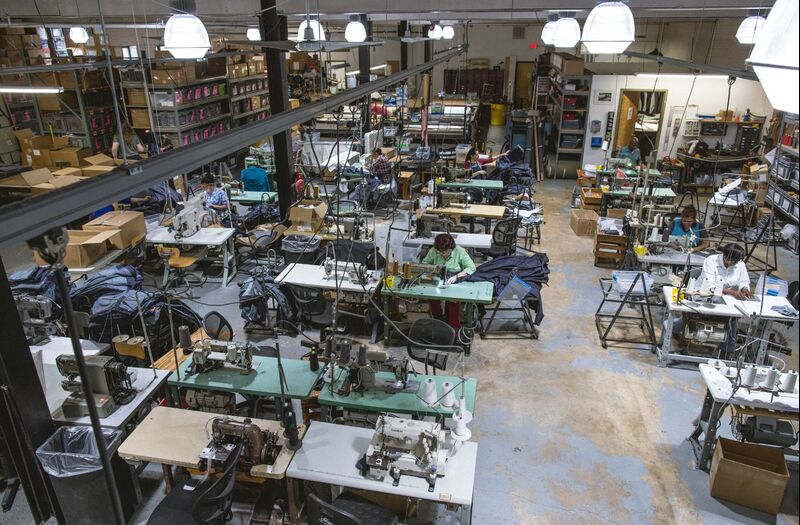
Raleigh Denim Workshop Source: Raleigh Denim Workshop Victor Lytvinenko is thumbing through emails on his iPhone trying to find the one that best shows the damage the global trade war has already done to his little, decade-old American jeans company.

The 37-year-old — dressed in a black t-shirt, rolled-up blue jeans and a pair of Stan Smiths — eventually looks up after finding the message. It’s from a customer in Scotland who’s apologizing for canceling an order worth tens of thousands of dollars. The reason? The shop owner balked at paying an additional 25 percent tariff the European Union slapped on American-made jeans in June as part of its response to President Donald Trump’s duties on steel and aluminum.

“We’ve already lost two accounts,” said Lytvinenko, who co-founded Raleigh Denim Workshop with his wife, Sarah Yarborough, in 2008. “That hurts.”

Lytvinenko was in Manhattan in late July for an apparel trade show. The annual trip was usually a fun excuse to catch up with customers or play ping pong over beers with friends also trying to earn a living making clothes in the U.S. But this year was different. The talk was very much about how American-made jeans — of all things — had been pulled into the trade spat.

Industry in Peril

It’s the latest gut punch for an industry that had already declined into a shell of what it once was. In the past year, two of the last-standing major denim mills closed, including the biggest: Cone Denim’s facility in Greensboro, North Carolina, that many firms say was the last to make high-end denim fabric in the U.S. on a large scale. Increases in California’s minimum wage also helped drive several apparel factories in Los Angeles to shutter or move to Mexico, adding to a tumultuous year for an industry that’s been just hanging on.

On top of that, free-trade agreements had been pushing blue jean-making overseas for two decades, and now the remaining manufacturers can’t believe the irony of getting hit by a return to protectionism. Major brands, like Levi Strauss & Co., had already largely bailed, shifting almost all of their production to Asia or Mexico. What’s left is mostly small businesses surviving by pitching craftsmanship and Americana in the premium end of the market with jeans priced at $200 or more.

“It’s another blow,” said Roy Slaper, who runs jeans-maker Roy Denim in Oakland, California. The tariffs don’t make sense economically because U.S. production is such a “microscopic” part of the global market, he said. The U.S. shipped just $31 million worth of jeans to the EU last year, or about 16 percent of the industry’s total global exports. “But politically, I can see why. Nothing is more American than jeans.”

Denim Birthplace

American blue jeans were born in San Francisco in the 1870s, and became a symbol of the frontier with Levis Strauss making the first pairs for miners working in the California gold rush. By the 1960s, they had evolved into a fashion emblem of cool and rebellion after pop icons like actor James Dean wore them. The EU no doubt had symbolism on its mind — it placed duties on bourbon, too.
600x-1.jpg

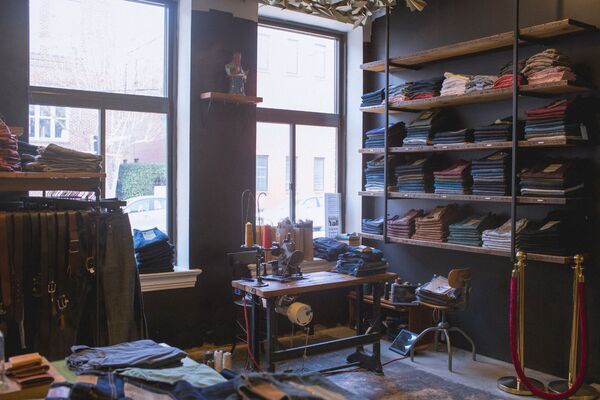
Source: Raleigh Denim Workshop
“They should put a tariff on hot dogs and apple pie, as well,” said Slaper, who has been making jeans for a decade. “I get it.”

Europe had already been a difficult market for American-made brands because it protected its apparel and textile industries. The EU had 12 percent duties on jeans in place, meaning that with the additional tariff, importers are now on the hook for 37 percent.

“It is a slap in the face,” for companies dedicated to American manufacturing, said Scott Morrison, the founder of New York-based premium denim company 3×1. With two decades in the industry, he’s one of the few to survive the great migration overseas. So far, the company has been sharing the cost of the tariff with a European distributor and avoided raising prices, but “we are not sure if it’s sustainable for a small business like ours,” Morrison said.

Supply Chains

The production of blue jeans is a testament to how global trade has evolved. The cotton can come from the U.S. and be made into denim in Pakistan. The cutting and sewing then might take place in Indonesia and finished off with buttons and zippers from China.

But making jeans still requires more labor than other clothing because of all the sewing and finishing touches like making them look distressed. And while moving production to lower-cost markets has reduced prices for consumers, it’s also given big companies even more advantages. Larger firms have the money and expertise to adjust their supply chains. Their clout also gives them leverage to pressure suppliers to take on cost increases. If they don’t oblige, production can be moved.

That’s what happened in L.A., with minimum wage hikes convincing some brands to source from Mexico — where labor is much cheaper, according to Ilse Metchek, president of the California Fashion Association.

“The issue is it’s so difficult to make it here,” said Metchek, who has been in the apparel business for more than 50 years. Los Angeles used to be this “cluster of denim, but not anymore.”

Of course, moving to Mexico is so advantageous because jeans can be shipped into the U.S. without any duties under the North American Free Trade Agreement. But Nafta is also what helps make Canada, a member of the pact, the industry’s biggest export market at more than three times the size of the EU at $108 million last year.

USA Revival?

There are other bright spots, too. A new denim mill is being built in Louisiana. Plus, Denimburg in Edinburg, Texas — a large mill that’s just a few years old — is witnessing increased demand for made-in-America fabrics from brands like Calvin Klein.

“We are seeing some signs that there are opportunities for a small revival,” said Mike Brown, who is commercial director for Denimburg and has been in the industry for four decades. “But it’s never going to be as big as it once was.”

Back at Raleigh Denim, which makes jeans at a 7,000 square-foot factory in the downtown of North Carolina’s capital city, Lytvinenko is still worried about the tariffs because some European customers aren’t responding to emails about their next round of orders.

“We’ve been viewing Europe as a huge market opportunity,” he said. “It’s a huge bummer because we’ve been growing every year, creating manufacturing jobs and building great products here in North Carolina. This hurts our prospects.”

Most Read