Trump’s Trade War Is Killing American Blue Jeans – Bloomberg

A few days ago I posted an article regarding planned legislation that “would hit the poorest kids the hardest” here in the US. In that post I pondered how many people who voted for the current administration (or didn’t vote at all) will be impacted by such legislation.

Here were are today with another potential example of voting against your own self-interests. I wonder if any of the business owners mentioned in this article voted for this administration, an administration which has put a policy in place that may lead to the swift end of their business. From what I gather from the article, their businesses were improving under the previous administration. I wonder how they felt about the previous administration.

As my good friend in Phoenix would say: “oh well…”

-Dr. Moore

https://www.bloomberg.com/news/articles/2018-08-03/made-in-usa-jeans-already-a-dying-breed-gutted-by-eu-tariffs

Trump’s Trade War Is Killing American Blue Jeans

Uliana PavlovaAugust 2, 2018, 9:00 PM PDT

  • Struggling U.S. industry becomes pawn in Trump’s trade war
  • ‘A slap in the face’ and ‘another blow,’ manufacturers say

800x-1.jpg

Raleigh Denim Workshop Source: Raleigh Denim Workshop Victor Lytvinenko is thumbing through emails on his iPhone trying to find the one that best shows the damage the global trade war has already done to his little, decade-old American jeans company.

The 37-year-old — dressed in a black t-shirt, rolled-up blue jeans and a pair of Stan Smiths — eventually looks up after finding the message. It’s from a customer in Scotland who’s apologizing for canceling an order worth tens of thousands of dollars. The reason? The shop owner balked at paying an additional 25 percent tariff the European Union slapped on American-made jeans in June as part of its response to President Donald Trump’s duties on steel and aluminum.

“We’ve already lost two accounts,” said Lytvinenko, who co-founded Raleigh Denim Workshop with his wife, Sarah Yarborough, in 2008. “That hurts.”

Lytvinenko was in Manhattan in late July for an apparel trade show. The annual trip was usually a fun excuse to catch up with customers or play ping pong over beers with friends also trying to earn a living making clothes in the U.S. But this year was different. The talk was very much about how American-made jeans — of all things — had been pulled into the trade spat.

Industry in Peril

It’s the latest gut punch for an industry that had already declined into a shell of what it once was. In the past year, two of the last-standing major denim mills closed, including the biggest: Cone Denim’s facility in Greensboro, North Carolina, that many firms say was the last to make high-end denim fabric in the U.S. on a large scale. Increases in California’s minimum wage also helped drive several apparel factories in Los Angeles to shutter or move to Mexico, adding to a tumultuous year for an industry that’s been just hanging on.

On top of that, free-trade agreements had been pushing blue jean-making overseas for two decades, and now the remaining manufacturers can’t believe the irony of getting hit by a return to protectionism. Major brands, like Levi Strauss & Co., had already largely bailed, shifting almost all of their production to Asia or Mexico. What’s left is mostly small businesses surviving by pitching craftsmanship and Americana in the premium end of the market with jeans priced at $200 or more.

“It’s another blow,” said Roy Slaper, who runs jeans-maker Roy Denim in Oakland, California. The tariffs don’t make sense economically because U.S. production is such a “microscopic” part of the global market, he said. The U.S. shipped just $31 million worth of jeans to the EU last year, or about 16 percent of the industry’s total global exports. “But politically, I can see why. Nothing is more American than jeans.”

Denim Birthplace

American blue jeans were born in San Francisco in the 1870s, and became a symbol of the frontier with Levis Strauss making the first pairs for miners working in the California gold rush. By the 1960s, they had evolved into a fashion emblem of cool and rebellion after pop icons like actor James Dean wore them. The EU no doubt had symbolism on its mind — it placed duties on bourbon, too.

600x-1.jpg

Source: Raleigh Denim Workshop
“They should put a tariff on hot dogs and apple pie, as well,” said Slaper, who has been making jeans for a decade. “I get it.”

Europe had already been a difficult market for American-made brands because it protected its apparel and textile industries. The EU had 12 percent duties on jeans in place, meaning that with the additional tariff, importers are now on the hook for 37 percent.

“It is a slap in the face,” for companies dedicated to American manufacturing, said Scott Morrison, the founder of New York-based premium denim company 3×1. With two decades in the industry, he’s one of the few to survive the great migration overseas. So far, the company has been sharing the cost of the tariff with a European distributor and avoided raising prices, but “we are not sure if it’s sustainable for a small business like ours,” Morrison said.

Supply Chains

The production of blue jeans is a testament to how global trade has evolved. The cotton can come from the U.S. and be made into denim in Pakistan. The cutting and sewing then might take place in Indonesia and finished off with buttons and zippers from China.

But making jeans still requires more labor than other clothing because of all the sewing and finishing touches like making them look distressed. And while moving production to lower-cost markets has reduced prices for consumers, it’s also given big companies even more advantages. Larger firms have the money and expertise to adjust their supply chains. Their clout also gives them leverage to pressure suppliers to take on cost increases. If they don’t oblige, production can be moved.

That’s what happened in L.A., with minimum wage hikes convincing some brands to source from Mexico — where labor is much cheaper, according to Ilse Metchek, president of the California Fashion Association.

“The issue is it’s so difficult to make it here,” said Metchek, who has been in the apparel business for more than 50 years. Los Angeles used to be this “cluster of denim, but not anymore.”

Of course, moving to Mexico is so advantageous because jeans can be shipped into the U.S. without any duties under the North American Free Trade Agreement. But Nafta is also what helps make Canada, a member of the pact, the industry’s biggest export market at more than three times the size of the EU at $108 million last year.

USA Revival?

There are other bright spots, too. A new denim mill is being built in Louisiana. Plus, Denimburg in Edinburg, Texas — a large mill that’s just a few years old — is witnessing increased demand for made-in-America fabrics from brands like Calvin Klein.

“We are seeing some signs that there are opportunities for a small revival,” said Mike Brown, who is commercial director for Denimburg and has been in the industry for four decades. “But it’s never going to be as big as it once was.”

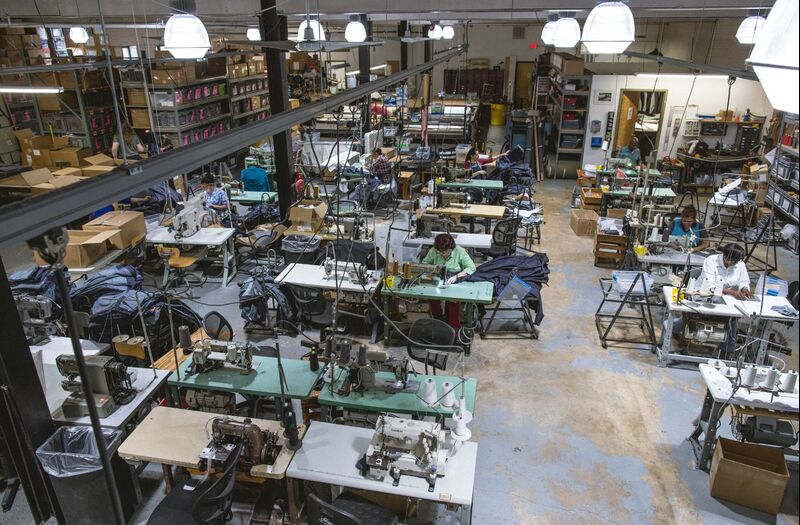
Back at Raleigh Denim, which makes jeans at a 7,000 square-foot factory in the downtown of North Carolina’s capital city, Lytvinenko is still worried about the tariffs because some European customers aren’t responding to emails about their next round of orders.

“We’ve been viewing Europe as a huge market opportunity,” he said. “It’s a huge bummer because we’ve been growing every year, creating manufacturing jobs and building great products here in North Carolina. This hurts our prospects.”

Most Read
Long Blockchain Gets Hit With SEC Subpoena After Nasdaq Ouster

Las year an ice tea company changed its name and corporate focus to “blockchain.” Now that company is on the verge of being kicked off Nasdaq and was recently subpoenaed (I needed spellchecker for that word) by the Securities Exchange Commission. Go figure. I’m not going to spend time discussing why the stock went from $1.70 before the change to $6.91 immediately following the “change,” to $0.34 today – because it makes no sense to me.

Long Blockchain Gets Hit With SEC Subpoena After Nasdaq Ouster
https://www.bloomberg.com/news/articles/2018-08-01/long-blockchain-gets-hit-with-sec-subpoena-after-nasdaq-ouster

Waymo’s Self-Driving Cars Are Near: Meet the Teen Who Rides One Every Day

This reminds me of the old “Jetsons” cartoon, except the car isn’t flying. Then again, were the Jetsons flying cars autonomous? Nevertheless, it seems like we are not far that far off from autonomous vehicles.

Tip: if you are graduating from high school anytime soon, and wish to be a taxi, bus, or truck driver, think about doing something else. Perhaps an engineering or computer science degree. Or, consider a vocational school the specializes in repairing these high tech vehicles.

Also, for all the uber and lyft drivers: be aware that when (not if) profit margins on autonomous vehicles exceeds that of uber/lyft paying you, uber/lyft will replace you with a robot. Save up now.

-Dr. Moore

Waymo’s Self-Driving Cars Are Near: Meet the Teen Who Rides One Every Day
https://www.bloomberg.com/news/features/2018-07-31/inside-the-life-of-waymo-s-driverless-test-family

LA-Bound LeBron James Opens School in Akron

Speaking of education, I wish LeBron and this school well. The way things are going, more efforts like this are needed.

LA-Bound LeBron James Opens School in Akron
https://www.bloomberg.com/news/articles/2018-07-30/la-bound-lebron-opens-school-in-akron-as-part-of-legacy

HUD’s Public Housing Plan Would Hit Poorest Kids the Hardest

I wonder how many people who voted for the current administration (and those who did not vote at all) will be impacted should this legislation pass? At least the administration appears consistent: consistently disregarding families, education, math, science, diplomacy, the environment, their own supporters, etc.

SMH

This too shall pass…

HUD’s Public Housing Plan Would Hit Poorest Kids the Hardest
https://www.bloomberg.com/view/articles/2018-07-30/hud-s-public-housing-reforms-shouldn-t-target-the-poorest-kids

Hate ETFs? Quants Say They Found Anomaly to Profit on Their Flows

During my doctoral studies I was told “no published trading strategy produces excess risk-adjusted returns.” Notice the two highlighted words: “published” and “risk-adjusted.” The first thought that came to mind when reading this article was “if this ‘strategy’ is so great, why are they telling me? Why aren’t they just printing money in private?”

As I read the article, I did not see any mention of risk. Another consideration is the time frame of ‘strategy’ profitability. A strategy that was profitable the past 10 years, then published, is not guaranteed to be profitable the next 10 years.

Keep these three things in mind when someone tells you about a “can’t lose” or “market beating” strategy:

(1) Why are you telling me this and not making money on your own in private? You should lever up and execute this strategy from your yacht in the Caribbean instead of wasting time and money talking to me.

(2) What about risk-adjusted returns?

(3) How do you know this strategy will work in the future? /How do you know the future?

Be aware.

Hate ETFs? Quants Say They Found Anomaly to Profit on Their Flows
https://www.bloomberg.com/news/articles/2018-07-19/hate-etfs-quants-say-they-found-anomaly-to-trade-against-flows

Nike Finally Thwarts Adidas Threat in U.S. With Shares Hitting a Record – Bloomberg

An interesting sub-plot is what Nike (and other corporations) are really doing with their tax break. Let me quote the article:

“Profit, meanwhile, got a boost from the corporate tax cuts passed last year in the U.S.. The company’s rate fell to 6.4 percent — half of its rate a year ago — and it shaved $82 million off its tax bill. The company also announced a $15 billion share buyback program, which will begin when its current $12 billion program concludes in the current fiscal year.”

The tax cuts were sold to the American public as a way to boost growth and investment in America. What the public wasn’t told was that the intended set of people who benefit from that growth: shareholders.  In other words, the tax cuts were to promote growth, growth in the wealth of a few.

I would argue one must be delusional to think Nike is going to use any of that $82 million tax savings to build a shoe factory here in the U.S.. What did Nike do instead? Nike increased their already high share buyback program ($12 billion of buybacks concludes this year) to start buying back $15 billion more when the current program complete.

Also, note the impact on employment:

“Nike has responded to its troubles in North America by reducing the number of retailers it sells to in the region, while also pushing more purchases through its own stores and websites. This was done to improve margins, by cutting out the middle man, and maintaining better control of how the brand is displayed.”

Reduce the number of retailers, push purchase online, cut out the middle man. I bet they outsource the development of their online website as well.

Allow me to be cynical for a moment: I didn’t vote for the tax cuts that lead to layoffs, continued outsourcing, and stock repurchases. I suppose I should not complain. Nike is part of the S&P 500 index fund that I own thus I make money as all of this transpires. Meanwhile, those who voted for this administration, e.g. laid off Harley-Davidson employees (followed by another stock buyback), suffer the consequences of their own vote. Yes, HOG (Harley Davidson) is part of that S&P500 index fund as well.

-Dr. Moore

https://www.bloomberg.com/news/articles/2018-06-29/nike-finally-thwarts-adidas-threat-in-u-s-as-shares-hit-record

Nike Finally Thwarts Adidas Threat in U.S. With Shares Hitting a Record

Matthew TownsendJune 29, 2018, 7:35 AM PDT
Photographer: Jason Alden/Bloomberg

business

By

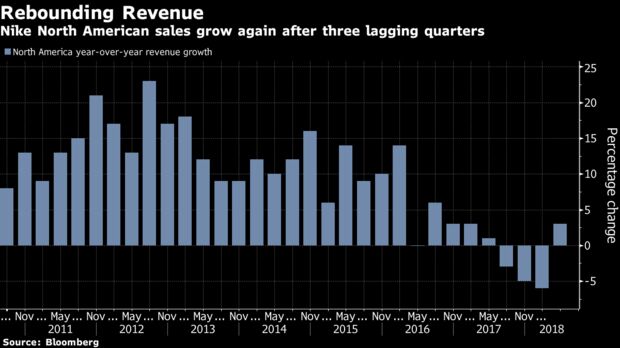
  • Sportswear giant reverses three quarters of U.S. contraction
  • Rival Adidas had been grabbing market share in North America

After several quarters on the bench, Nike Inc. has finally healed the damage inflicted by Adidas AG.

Nike increased sales in North America for the first time in a year, after its smaller European rival had been outmaneuvering the sneaker giant on its home turf. Nike’s improved performance, sparked by new products and a smartphone shopping app, unleashed a slew of praise from Wall Street analysts. The stock surged as much as 13 percent to a record high in Friday trading.

“A key part of Nike’s story has fallen into place with the strong return to growth of its largest market,” said Chris Svezia, an analyst for Wedbush Securities Inc. “Nike product is making a clear comeback.”

620x-1.png

For more than a year, the Beaverton, Oregon-based company has been promising investors that slowing growth and revenue declines in its largest market were only a short-term trend. Nike said the lion’s share of the blame fell on U.S. retail partners, which have been closing stores amid a broader industry retrenchment. But it also faced a rejuvenated Adidas, which has regained its cachet with consumers and been posting growth rates in North America of about 20 percent.

Even as Nike was caught off guard in the U.S., the company restored the confidence of investors and analysts over the past year with its international performance. Its rapid growth overseas, where it generates more than half its revenue, continued last quarter with sales surging 35 percent in China and 24 percent in the region that includes Europe, the Middle East and Africa.

Regional Response

Nike has responded to its troubles in North America by reducing the number of retailers it sells to in the region, while also pushing more purchases through its own stores and websites. This was done to improve margins, by cutting out the middle man, and maintaining better control of how the brand is displayed.

The improvement in North America prompted the company to nudge up its outlook for the current fiscal year. Nike is now forecasting annual sales growth in the high single digits, as opposed to a previous estimate for growth in the mid- to high single-digits.

Last quarter’s results also came when the company responded to a misconduct scandal by pushing out a handful of high-ranking executives after an internal review. The offending behavior skewed toward bullying and unfair treatment of women. Most of the Wall Street analysts covering Nike who addressed the incident said the loss of talent and bad press would have little impact on the company’s performance, and last quarter backed that up.

Related: Nike’s Executive Exodus Shows Bullies Don’t Make Good Bosses

Profit, meanwhile, got a boost from the corporate tax cuts passed last year in the U.S.. The company’s rate fell to 6.4 percent — half of its rate a year ago — and it shaved $82 million off its tax bill. The company also announced a $15 billion share buyback program, which will begin when its current $12 billion program concludes in the current fiscal year.

Overall sales were $9.8 billion, surpassing analysts’ average estimate of $9.4 billion.

“Everything is pointing in the right direction,” said Chen Grazutis, an analyst for Bloomberg Intelligence. “The top line is clicking again, and they are gaining traction with new products.”

Amazon Makes Big Foray Into Health Care With PillPack Purchase

The robots keep coming! I frequently post articles highlighting the need to get familiar with building using and replacing robots and programs or get replaced by automation. This is another example although the automation angle is subtle. The company Amazon acquired automates many of the functions pharmacists carry out. Amazon, with their vast computing resources, can expand the functions that are automated.

So to those in pharmacy school now or working in a pharmacy: get familiar building / using / maintaining the software and systems that automate your work. If you do not, you may get replaced by those systems.

-Dr. Moore

Amazon Makes Big Foray Into Health Care With PillPack Purchase
https://www.bloomberg.com/news/articles/2018-06-28/amazon-makes-big-foray-into-health-care-with-pillpack-purchase

The Future of Tesla Hinges on This Gigantic Tent

As a follow up to my earlier post on the ability to mass produce electric cars profitability, now we consider quality. The article ends with a quote from someone experienced with automobile manufacture:

“I pity any customer taking delivery of one of these cars. The quality will be shocking.”

I don’t think he is implying high quality.

Enjoy the read,

-Dr. Moore

The Future of Tesla Hinges on This Gigantic Tent
https://www.bloomberg.com/news/articles/2018-06-25/the-future-of-tesla-hinges-on-this-gigantic-tent

Carmakers Risk Wasting Billions on Electric, Autonomous Vehicles

Sometime ago I posted an article on the “greenness” of electric cars. That post pointed out the greenness of an electric car depends on the greenness of the electrical grid used to charge the vehicle. Charge your Tesla or Leaf during peak hours in a region using coal-fired power plants and you are no more green, and perhaps less green, than a standard gasoline powered car.

Turning away from the environmental perspective and towards the producer perspective, the article linked below raises concern about profitability of electric car manufacture. Profitable production of price-competitive electric vehicles is not a task that can be presumed a slam dunk. Time will tell.

-Dr. Moore

Carmakers Risk Wasting Billions on Electric, Autonomous Vehicles
https://www.bloomberg.com/news/articles/2018-06-20/carmakers-seen-wasting-billions-on-electric-autonomous-vehicles