Ex-IMF chief Dominique Strauss-Kahn cleared in pimping trial

This is a little off-subject from my typical posts. However, as I prepare to procure some EfficientMinds coffee mugs with my famous quotes, I could not help but share this article.

DSK was cleared of “aggravated pimping,” a phrase I never heard of until this morning. I know nothing of this case or person. However, if DSK must be a pimp he could at least be a “compassionate pimp.”

Enjoy your morning coffee everyone.

http://www.usatoday.com/story/news/world/2015/06/12/dominique-strauss-kahn-imf-sex-trial/71109916/

The $30 Hot Dog Man Is a New York City Hero

I hope none of the Student Investment Fund students bought one of these hot dogs while in NY. The article does bring up a humorous yet curious thought: are we all just “tourists” on Wall Street as we invest?

http://gawker.com/the-30-hot-dog-man-is-a-new-york-city-hero-1706262619

Why isn’t the tech boom helping the economy? | Nishant Bhajaria | LinkedIn

I found this an interesting read as a former high tech person still connected to that community. This article made me wonder about the “triple bottom line” of people, profit, and planet yet again.

For example, Apple has $200 billion in the bank (in overseas accounts to avoid taxation). If they manufactured phones in the U.S. would Apple have only $20 billion in a U.S. Bank? Wouldn’t that benefit the broader U.S. economy more than the current situation of concentrated wealth via Apple shares?

I know, Steve Jobs said those jobs will never come back to the U.S. However, he is not God and no one has a monopoly on the truth. Or maybe the status quo is just fine with Marx and Schumpeter mistaken about the inevitable self-inflicted demise of capitalism.

https://www.linkedin.com/pulse/why-isnt-tech-boom-helping-economy-nishant-bhajaria

Apple Assigned “AA-” Credit Rating by Morningstar (AAPL)

On Tuesday I explained why Apple, with roughly $200B in short term and long term investments, borrows money to pay dividends: it is better to pay 5% interest than 30% or so in taxes to repatriate the cash in Caribbean bank accounts back to the U.S.

However, I also mentioned that Apple can’t borrow forever. Bankruptcy risk increases with debt and the borrowing cost (interest rate) will rise also. Then I see this article regarding Apple’s AA- rating. Expect the rating to drift downward if Apple continues to borrow to avoid taxes.

http://www.dakotafinancialnews.com/apple-assigned-aa-credit-rating-by-morningstar-aapl-2/134983/

Apple, Google poaching settlement appears headed for approval

I may have posted on this topic before so please forgive me. In my previous post regarding CEO to worker pay ratios I mentioned a recent debate of mine. In that debate the defender of the 1% also defended local companies conspiring not to take each other’s employees. Well, as you can see from the Reuters article that appears to be illegal.

From a higher level view, how can one preach less regulation / free markets yet support a non-free labor market by engaging in practices that restrict mobility? Sheer hypocrisy I suppose. Be it big guys like Apple or Google or little guys like small local companies.

Just trying to raise awareness…

http://mobile.reuters.com/article/idUSKBN0LY14Q20150302

Report: CEOs Earn 331 Times As Much As Average Workers, 774 Times As Much As Minimum Wage Earners

Last night I had a discussion with someone regarding the widening income gap. At that time I mentioned the average executive-to-laborer pay went from about 60X in the 1960s to 600X today. In search of a data to support a memory of something I read years ago I performed a Google search. The first article that showed up was an interesting Forbes article from last year titled "Report: CEOs Earn 331 Times As Much As Average Workers, 774 Times As Much As Minimum Wage Earners.”

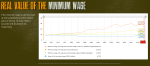
The Forbes article references a pretty cool graphical presentation on the matter by the AFL/CIO. My discussions last night led to a good point argued by many defenders[1] of the 1%: that workers are paid based on their productivity. However, looking at the data, workers are NOT paid based on their productivity on average. They are actually paid significantly less.

For example, if minimum wages kept up with productivity gains minimum wage would have grown to $18.30. However, minimum wages actually went down (in real dollars) since 1968 to the level of $7.25 in 2013. So where does the $18.30-$7.25=$11.05 go? To charitable organizations or executive pay? Maybe a little of both but I suspect most finds its way to executive compensation.

Some good news: results are based on averages. Therefore some companies are above (worse) and some are below (better) with the ratio of CEO-to-worker pay. Some time ago I thought about developing a score to rate companies and raise awareness of where a company falls in the CEO-to-worker pay spectrum. The AFL/CIO has already done similar work with their report card on 78 of the largest mutual funds.

With broader awareness perhaps the 99% could gradually migrate their investments (401k/IRA), purchases (where they shop), and employment (where they work) away from the worst companies and toward better companies. Perhaps that could help reverse the trend of the disappearing middle class and put us back on track to shared prosperity. Quizas, Quizas, Quizas.

I’ll leave with two graphs from the fancy graphical website referenced by the Forbes article, I hope it comes through in this post. If not, just visit the Executive Paywatch 2014 website and scroll down.

[1] The irony is most defenders of the 1% are not in the 1%. People are defending the status quo which will lead to further widening of the income and wealth gap. I don’t know what is best for someone else. However, defending a position that makes yourself personally further behind (relative to 1% income/wealth) is defending concentrated prosperity. Marx and Schumpeter had some pretty grim predictions about what happens after prosperity concentration.

Nobel prize-winner Stiglitz: Three steps to solve income inequality – Yahoo Finance

An interesting video by a Nobel Prize winner. Consider this another voice in the chorus bringing attention to the widening income and wealth gap.

http://finance.yahoo.com/news/nobel-prize-winner-stiglitz—three-steps-to-solving-income-inequality-153834471.html

Vanguard’s Partly Automated Service: Just Don’t Call It ‘Robo Adviser’ – WS J

This is related to an earlier post regarding advisors choosing high fee funds so they can receive kickbacks. A commentator asked what should advisors charge. I gave a long answer then suggested 0.25% and then invest only in low cost index funds (no kickback funds).

Then today I came across this article. Apparently Vanguard and Schwab are already on top of this. The article points out that the “hybrid” Vanguard model charges 0.3% and invests only in low cost index funds.

So, I wasn’t too far off with the 0.25% suggestion. We will experience increasing competition in the financial advisory business. This article reveals some of the emerging competition already at play.

http://www.wsj.com/articles/vanguards-partly-automated-service-just-dont-call-it-robo-adviser-1428375815