Software Engineer Loses Life Savings in Quadriga Imbroglio

What about diversification? The old saying “don’t put all your eggs in one basket” surely would have prevented the loss of this person’s entire life savings. Well, at least he is young and has time to recoup. I’d like to ask him if he would invest in crypto again.

I hear proponents of crypto say things like “I’m betting on the technology,”(with little training or experience in software engineering and cryptography) “it can’t be hacked,” and “it is more secure than government backed dollars.” This sounds similar to the lies sold to people regarding diamonds “diamonds are forever,” “diamonds are scarce,” and “diamonds are an investment.”

Ironically, the same government that backs currency is needed to rule in the favor of those who lost money playing the crypto game – an “I don’t need you until I do” type situation.

-Dr. Moore

Software Engineer Loses Life Savings in Quadriga Imbroglio
https://www.bloomberg.com/news/articles/2019-02-09/software-engineer-loses-life-savings-in-quadriga-imbroglio

Harley-Davidson Profit Is Wiped Out by President Trump’s Tariffs

The administration’s tariffs on EU steel and aluminum led to reciprocating tariffs by the EU on Harley’s imports. Then Harley decides to expand production in Thailand to get around those tariffs. A move associated with the goal of a firm: maximize shareholder wealth. A move necessitated by ill-conceived policy.

From there, the same President that lifted up Harley in the beginning as a point of national pride, tells that same nation he would support a boycott of Harley. Harley sales decline 10% domestically. Even with the corporate tax break giveaway by the current administration, Harley still reports no profit. And our government budget deficits and national debt continue to rise due to lower tax revenue collections on lower output like Harley.

Did everyone follow that?

I prefer to use whole words rather than twitter-like disemvowelments, but I must use one here: SMH

Read, and ride, on.

-Dr. Moore

Harley-Davidson Profit Is Wiped Out by President Trump’s Tariffs
https://www.bloomberg.com/news/articles/2019-01-29/harley-profit-wiped-out-by-tariffs-as-sales-continue-slumping

That Flying-Car Future Looks Like a Dystopia

So these flying cars have roots in inefficient helicopters, when measured by fuel consumed per passenger mile. The article also makes an important point: if you invest in public transportation infrastructure on the ground, the need to “fly above the fray” is mitigated. The article cites Tokyo as an example. I’ve never been. If you have, please comment on the Tokyo public transit infrastructure. I’d like to hear how smooth (or non-smooth) it is.

-Dr. Moore

That Flying-Car Future Looks Like a Dystopia
https://www.bloomberg.com/view/articles/2019-01-27/do-flying-cars-have-a-future-just-look-at-helicopters-for-a-clue

Too Many Americans Will Never Be Able to Retire

To the chagrin of many current and future students, it looks like I must work well into my 60s…

Seriously though, this article provides interesting perspective on population trends and economic impacts of immigration policy. You guessed it, a more inclusive policy (that is enforced) is better for the long-term health of the nation.

-Dr. Moore

Too Many Americans Will Never Be Able to Retire
https://www.bloomberg.com/view/articles/2019-01-23/america-needs-more-young-workers-to-support-aging-population

Why the Quants Aren’t Adding Up

This article points out an interesting contradiction in the quantitative approach “that the approach exploits inefficiencies, but requires market efficiency to realign prices to generate returns.”

Perhaps the old saying “success is a journey, not a destination” applies…

-Dr. Moore

Why the Quants Aren’t Adding Up
https://www.bloomberg.com/view/articles/2019-01-19/quant-funds-poor-performance-may-not-be-temporary

Foreign Students Sour on America, Jeopardizing a $39 Billion Industry

Interesting read. I never thought of higher education as a service that we export, every bit as important as soybeans and coal – perhaps more important. That is an interesting perspective consistent with reality. Soybean crop values totaled $38 billion in 2016: USDA website. Coal exports in 2018 were about $9 billion: EIA website. Hopefully, someday, we can get back to policies that promote education here in the U.S., welcome students from abroad, and thereby help our economy in the near and long-term.

-Dr. Moore

Foreign Students Sour on America, Jeopardizing a $39 Billion Industry
https://www.bloomberg.com/news/articles/2019-01-17/foreign-students-are-a-39-billion-industry-trump-is-scaring-them-off

Globalization Is Surviving Trump

Our President has barred the U.S. delegation from the World Economic Forum in Davos, Switzerland – over a government shutdown caused by his demands for a border wall with Mexico. Both acts indicate a lack of interest in global trade (even though the President and his family profit from global trade.) Nevertheless, here are a few quotes from the article:

“the rest of the world appears to have decided globalization isn’t the enemy after all, and that leaves the U.S. playing trade catch-up.”

“closing up is not the answer”

“Shortly, the vast majority of economic growth will be taking place outside the West”

One Trump-supporting cattle rancher stated “If we don’t have a bilateral deal with Japan in three years, we are going to have some problems.”

Wait a second, did that cattle rancher, that allegedly believes in globalization, understand the trans pacific partnership deal already in place from the Obama Administration (and exited by Trump), already provided access to Japan and other markets? Was he vocal about his support of the Obama Administration that forged an agreement (TPP) to help his cattle business? Perhaps not but I leave it to the readers to ponder why someone would not support an administration that has helped them while supporting another that harms them.

-Dr. Moore

Globalization Is Surviving Trump
https://www.bloomberg.com/news/articles/2019-01-18/globalization-is-surviving-trump

Trump’s Tariffs Are Producing Billions, But China Isn’t Paying

So these tariffs are not paid by the Chinese people, companies, or government. Rather, tariffs are paid by U.S. business (e.g., higher input costs such as aluminum and steel) and U.S. consumers (e.g., higher prices on products at WalMart). The retaliatory tariffs from China on U.S. agricultural products reduced demand. Demand for things like soybeans reduced so much that crops are left to rot in the field. Then the government promises to pay farmers billions which apparently adds up to most of the tariffs collected by the government. Then the government shutdown causes concern about the ability to even write the check to the farmers promised payment for not farming.

If you follow those facts, you could conclude that U.S. businesses and consumers are paying farmers to be idle. Doesn’t make much sense to me. Then again, I don’t understand much of the “policy” coming from this administration. If you read the article below, you will see that policy makers from the Reagan and Bush administrations don’t see the benefit of this trade war either.

-Dr. Moore

Trump’s Tariffs Are Producing Billions, But China Isn’t Paying
https://www.bloomberg.com/news/articles/2019-01-17/trump-s-tariffs-are-producing-billions-but-china-isn-t-paying

Keeping Wall Promise Is Blocking Other Signature Trump Pledges

Long ago I posted an article from the Smithsonian (now closed due to the government shutdown) regarding the difficulties in building the proposed border wall:

https://efficientminds.com/2017/02/07/smithsonian-what-geology-has-to-say-about-building-a-1000-mile-border-wall/

Now we see the ripple effects of President Trump demanding American taxpayers pay, via our own government budget, for the wall that he himself said some 20+ times would be paid for by Mexico (http://fortune.com/2018/12/13/trump-mexico-border-wall/).  Those 800,000 federal workers on furlough or working without pay were not enough to have our President “get off the wall” (sorry, had to use the pun). Now we see the profits of big corporations negatively impacted by the government shutdown. Perhaps that will be enough.

-Dr. Moore

Keeping Wall Promise Is Blocking Other Signature Trump Pledges
https://www.bloomberg.com/news/articles/2019-01-10/keeping-wall-promise-is-blocking-other-signature-trump-pledges

Apple’s iPhone Warning Comes Years Too Late – Bloomberg

A couple quotes from the article:

“But there is a limit to how many people are willing to pay $1,000 out of pocket for a new phone, and it seems as if Apple reached that limit all at once. “

$1,000 is pretty steep for a phone, especially when the advantages over my iPhone 7S seem minimal. On one hand, Apple makes great products that last a long time. On the other hand, great long-lasting products don’t get replaced often.

This is where Microsoft’s focus on enterprise, cloud services, and subscriptions is paying off in the form of continued revenue growth. Apple has been consumer-first rather than enterprise-first from the beginning. Unfortunately, they are running out of consumers for $1,000 iPhones. Yes, services like Apple Music are an attempt to generate service-based revenue. I just don’t see the same growth potential in individual music subscriptions as in enterprise software and cloud services.

Another quote from the article:

“This isn’t to say that Apple’s business is falling apart. It is still generating levels of revenue and cash flow that are the envy of the corporate world. But Apple failed in the No. 1 mission of being a public company: being honest with investors about its business. The company simply denied the reality that was staring it in the face, until denial was no longer an option. “

To Student Investment Fund Microsoft fans of the past (Peter, David): I humbly apologize for disregarding Microsoft as “not competitive with Apple” and “doesn’t add to diversification.” I was wrong. In retrospect, Microsoft with business customers and Apple on the consumer side would have been a good combo meal.

-Dr. Moore

https://www.bloomberg.com/opinion/articles/2019-01-02/apple-s-iphone-warning-comes-years-too-late

Apple’s iPhone Warning Comes Years Too Late

The company has reached the end of its denial phase.

Shira OvideJanuary 2, 2019, 2:42 PM PST
1000x-1.jpg

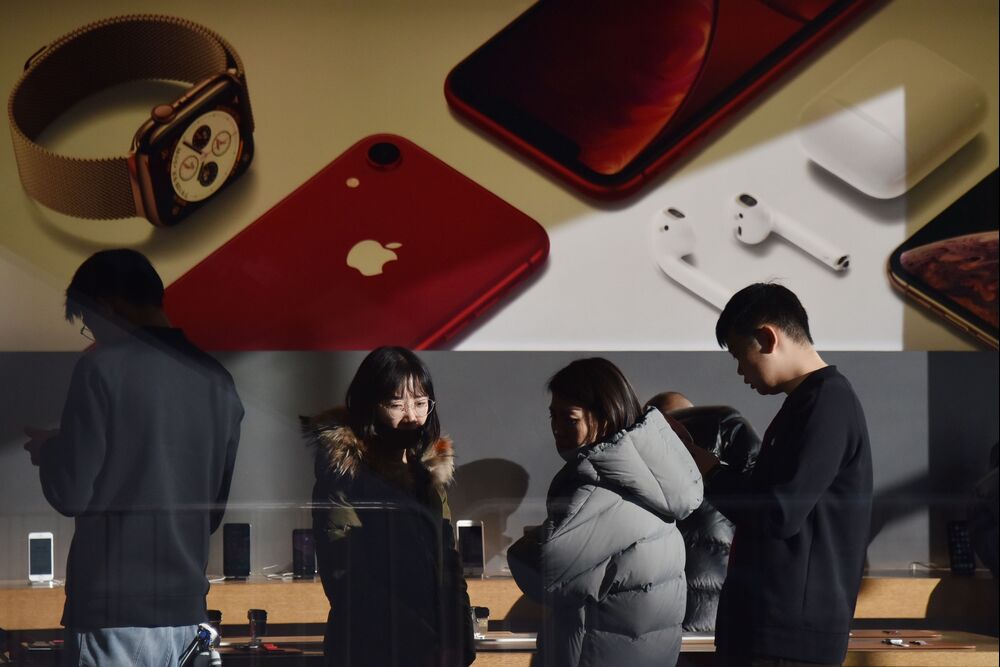
China could be the new “weather” for sales shortfalls.
Photographer: Greg Baker/AFP/Getty Images
The optimistic narrative about Apple Inc.’s iPhone business is falling apart in front of our eyes.

The company on Wednesday stunningly slashed its own revenue forecast for its first fiscal quarter that ended in December. Apple led by blaming a slowing economy in China and the trade skirmish with the U.S. for worse-than-expected consumer transactions in the region that includes China, Taiwan and Hong Kong. Apple said its first quarter revenue is now expected to fall about 5 percent from a year earlier. China may be the new “weather” — a go-to excuse for companies whose sales aren’t up to snuff.

But that wasn’t all. In an extraordinary letter to Apple investors, CEO Tim Cook also told stockholders what he should have been saying for years: The company’s iPhone business has shifted into a lower gear because of changes in the smartphone market and consumer behavior. This should have been absolutely predictable to anyone who was able to peer outside of Apple’s bubble. Executives have failed in their duty to warn investors ahead of time about all this, and reality is finally and all at once catching up to Apple.

In his letter, Cook said in some established markets outside of China, iPhone “upgrades also were not as strong as we thought they would be.” (Upgrades are people with older-model iPhones opting to buy new models.) The company attributed that to economic weakness in some countries but also other factors, including people holding onto smartphones longer as mobile phone companies halt subsidies, the climbing prices of Apple’s devices, and users taking advantage of lower-cost battery swaps rather than purchasing the latest and greatest iPhones.

In addition, Cook wrote on Wednesday that economic conditions slowed in China in the second half of 2018 and that shopping traffic was hurt by uncertainty about the U.S.-China trade war. Here, too, Apple missed opportunities to caution investors.

Cook said two months ago that Apple’s China business was “very strong,” even amid signs of an economic slowdown and months of headlines about trade tensions with the U.S. He consistently told investors that he thought the U.S. and China would resolve their trade dispute amicably and didn’t give any indications that consumers were on edge or reluctant to shop because of the geopolitical fracas. It’s possible that the last couple of months of economic circumstances in China, Taiwan and Hong Kong caught Apple by surprise, but executives failed to give any hints of red flags in the region.

It’s possible conditions in China changed quickly, but the broader trends in smartphone activity are not new. Why didn’t Cook make any of these admissions before now?

Phone companies in the U.S. and some other big smartphone markets have for years sought to stop offering people iPhones at an artificially low price of $200 as they did in the iPhone’s earlier days. That factor — plus less drastic changes to each year’s model of iPhone or other smartphones and the rising prices of some new devices — has led people in the U.S. to keep their smartphones for more than three years on average, up from about two years in 2014, according to mobile industry consultant Chetan Sharma. Apple sells by far the majority of new iPhones to people who already owned one of the devices, which means sales are dinged if someone wraps electric tape around her three-year-old iPhone and soldiers on.

This is a trend years in the making. But at each and every opportunity, Cook has dismissed questions about whether changes in upgrade behavior will hurt Apple’s revenue.

In an August conference call with stock analysts, one of them asked Cook whether the company could continue to sell more iPhones in a few years in light of the smartphone market’s stagnation. Cook said he thought Apple could sell more phones to people who already owned iPhones, to those who had competing devices and to people who had never owned a smartphone. It was an answer straight out of 2015, when everything Cook said was true. It’s not true anymore, and Cook should have known that.

The research firm IDC estimates global sales of smartphones declined slightly in 2018, as they did in 2017. Apple seemed to defy that smartphone gravity for a long time, but it didn’t. In Apple’s fiscal year ending in September, Apple barely sold more iPhones than it did the previous year. Revenue increased because Apple charged a super-premium price for the iPhone X and other new models — and Apple loyalists paid those higher prices. But there is a limit to how many people are willing to pay $1,000 out of pocket for a new phone, and it seems as if Apple reached that limit all at once.

This isn’t to say that Apple’s business is falling apart. It is still generating levels of revenue and cash flow that are the envy of the corporate world. But Apple failed in the No. 1 mission of being a public company: being honest with investors about its business. The company simply denied the reality that was staring it in the face, until denial was no longer an option.

This column does not necessarily reflect the opinion of the editorial board or Bloomberg LP and its owners.

To contact the author of this story:
Shira Ovide at sovide

To contact the editor responsible for this story:
Daniel Niemi at dniemi1

Before it’s here, it’s on the Bloomberg Terminal.
LEARN MORE