
http://www.reuters.com/article/2012/09/25/us-google-iphone-idUSBRE88O07U20120925
Author Archives: efficientminds
Learn the material
What does “Learn the material” mean to you? Does it mean simply attending class? Does it mean scanning through the textbook? Or, does it mean doing whatever you need to do to learn the material?
As exams approach I occasionally receive emails of the nature “I am just not grasping the information.” Well, this may be a surprise to some, but odds are you will not learn 100% of the material by just attending a lecture. In fact, in my 11 years of college education, after three degrees, at three schools, in three different states, only once can I remember learning all the material by simply attending the lecture. Even then, I had to rehearse what I learned by doing assigned homework. For the 99.9% of the other classes I had to obtain different books, work with study groups on occasion, stop by the professor’s office hours, email the professor, and stay in the library until it closed most days of the week. Are you doing that?
A student taking one of my classes is fortunate. I have made a wealth of resources available. Allow me to summarize what is available to you:
- efficientminds.com: Entire lecture notes
- efficientminds.com: Eight Learning Modules such as this one on Risk and Return.
- efficientminds.com: Extra credit explanations
- efficientminds.com: Homework helpers
- efficientminds.com: Additional finance-related posts such as this one
- efficientminds.com:: Microsoft Excel examples
- A wealth of supplemental articles and links to video organized by topic on my Google Drive.
- The end of chapter problems in your textbook.
- Alternate textbooks on library reserve:
- Ross, Westerfield, and Jaffe. Corporate Finance, ninth edition
- Parrino and Kidwell. Fundamentals of Corporate Finance, University of Memphis edition.
- Brigham and Daves. Intermediate Financial Management, ninth edition.
- Thousands of worked out example problems organized by topic (use the table of contents and index), also on library reserve:
- Schaum’s Outline of Mathematics of Finance
- Schaum’s Outline of Financial Management
- Schaum’s Outline of Basic Business Mathematics
- BlackBoard
- Homework with feedback
- Discussion forums
- Business student services Business Tutoring Program
- The internet: Google searches, Investopedia, Khan Academy, YouTube, etc.
- My office hours (and I make appointments if the regularly scheduled time does not work for you).
- My email
So, whenever a student tells me “I am not grasping the material” I must question if that student has utilized the long list of available resources. If, and that is a big if, after going through the whole list and spending 7 hours/week outside of the class studying you are not grasping the material then we need to talk.
Finally, and I must admit frustration here, is the comment “the exams don’t match the homework” or “the homework is totally different from the lecture” or “the lecture is totally different from the book.” I believe all such statements are bogus.
To begin, the homework problems are selected from the CD that came with the instructor’s edition of the textbook. I base my exams off the same CD. So the book-homework-exam connection is irrefutable. Now, as of Fall 2012 I must give a final exam prepared by committee. The wording of that exam will vary from the wording of my textbook. However, we are all supposed to understand English and the material leading up to the final. Also, I asked one student in the Fall 2012 semester “what did you think of that final?” His reply? “It was a gimmie compared to your exams.” Moral of the story: if you understand English and understand the material you will do well on the final.
Now, regarding my lecture notes. Guess what I based them on? You got it. The same textbook. So the book-lecture-lecture note-homework-exam connection is also solid. I interpret any comments suggesting that connection is weak as “I really haven’t spent the necessary time.” or “I am lazy and I am asking you to work out the same problem in class that is on the homework that is on the exam. Do not give me any problems worded in different ways. I just want to pass the exams.” This is related to the spoon-feeding I spoke about in this post (be sure to read the comments to that post also).
Let me end with a quote from my very first calculus class at Purdue University back in 1990:
Do not study for the test. Study to learn the material and the test will be easy.
I sure hope you heed that timeless advice not only in my class, but all of your classes.
Stern Advice: How you, too, can cash in on Romney tax breaks | Reuters
The article makes a good case for buying stocks directly rather than indirectly (lower tax bill on gains). There is yet another advantage to buying stocks directly: you avoid paying management fees to mutual fund companies.
There is a significant drawback not mentioned in the article. Poor people like us can not buy a fully diversified portfolio. If you have millions, buying all 500 of the S&P 500 is possible. If you have $1,000 it is not.
Another thought comes to mind: what are the taxation rules on an ETF? Here’s an extra credit assignment for you: prepare a table that compares the taxes on realized gains, unrealized gains, and dividends for mutual fund shares, individual stock shares, and ETF shares. One page and please cite your sources (website, irs code, textbook, previous article, etc.).
http://www.reuters.com/article/2012/09/26/column-personalfinance-idUSL1E8KP4YL20120926
Harvard, Stanford Researchers Find Leaders Are Less Stressed – ABC News
Tesla Told to Speed Repayment of U.S. Electric-Car Loan – Businessweek
- This is a good example of bond covenants. You will notice at least two mentioned in the article: the ratio of current assets to current liabilities and the ratio of total liabilities to total equity.
- We talked about development bonds in class. Perhaps the Tesla case would have been better served by development bonds than a government loan. By using a development bond, Tesla would raise money from private markets rather than the government. However, don’t be fooled. As mentioned in class this still costs the government in lost tax revenue on bond interest. That is okay if additional revenue from sales and income tax as a result of a successful Tesla materialize.
- Note that Goldman Sachs is in the mix again.
2012H2 FIN101 XC03 – Lowpoint coffee example
Lowpoint coffee’s after-tax cash flows are currently $100,000 annually but will grow at 3% indefinitely. With a 15% discount rate how much should Starbucks offer to takeover this mom-and-pop coffee shop assuming a 15% discount rate?
Using the present value of a growing annuity formula:
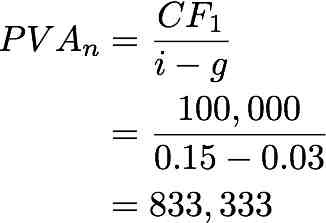
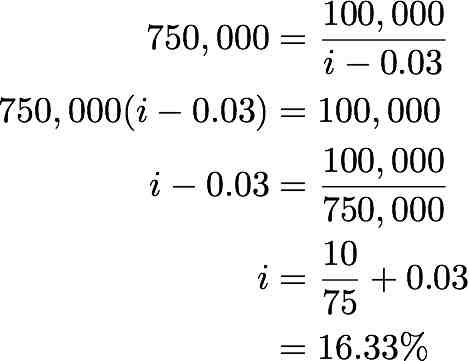
Internally, Starbuck’s knows this is what Lowpoint is worth. However, upper management would like to offer $750,000 instead. At what interest rate can a $750,000 offer be justified? Just rearrange the PVA formula a bit:
2012H2 MBA220 XC01a – Proof of PVAn simplification
2012H2 MBA220 XC02 – Portfolio risk and return two ways
Here is the spreadsheet: Portfolio_risk_two_ways
Apple supplier closes China plant after riot – Asia Stocks to Watch – MarketWatch ?
Updated JO stock screening presentation is now available
Visit:
https://efficientminds.wordpress.com/education/learning-modules/j-o-stock-screening/
Below the presentation you will find performance data for all JO strategies and an example of the Trending Value screen applied to all stocks with a market capitalization > $200 million.
 Efficient Minds™