Bloomberg: U.S. Firms Hold Record $1.64 Trillion in Cash With Apple in Lead

Please read the entire article. There is actually some good news at the very end: $800B+ in capital spending and $300B+ in dividend payouts last year. That will help the money circulate a little bit. I wonder how much cash is generated annually to enable such large stockpiles and payouts…

From Bloomberg, Mar 31, 2014, 8:36:53 AM

U.S. companies outside of the finance industry are holding more cash on their balance sheets than ever, with $1.64 trillion at the end of 2013.

To read the entire article, go to http://www.bloomberg.com/news/2014-03-31/apple-leads-u-s-companies-holding-record-1-64-trillion.html
Sent from the Bloomberg iPhone application. Download the free application at http://itunes.apple.com/us/app/bloomberg/id281941097?mt=8

Bloomberg: Two Husbands Accused of Trading on Wives Overheard Talk

Already married to someone wealthy? Why not eavesdrop on their phone calls and trade on insider information? The rich must get richer I suppose. Or pay fines. I wonder if the couples are still married. I wonder what the husbands do for a living. Maybe the husbands did not work. That would allow time and energy for them to listen to their wives’ phone calls since they had nothing else to do. Maybe their wives did not give them a large enough allowance. Maybe they are just greedy. Or, all of the above. 🙂

From Bloomberg, Mar 31, 2014, 12:14:43 PM

Two California husbands who allegedly heard their executive wives discussing nonpublic information on the phone were sued for insider trading by the U.S. Securities and Exchange Commission.

To read the entire article, go to http://www.bloomberg.com/news/2014-03-31/two-husbands-accused-of-trading-on-wives-overheard-talk.html
Sent from the Bloomberg iPhone application. Download the free application at http://itunes.apple.com/us/app/bloomberg/id281941097?mt=8

The Trillions of Dollars U.S. Companies Are Hoarding Overseas – Atlantic Mobile

All I can add is amen.

http://m.theatlantic.com/business/archive/2014/03/the-em-trillions-em-of-dollars-us-companies-are-hoarding-overseas/359928/?google_editors_picks=true

2014 GAME IV Conference notes available

Guess where you can find a presentation (including YouTube video links) of my notes from the 2014 GAME IV conference?  That’s right, my website!  If you choose to view the YouTube videos please make sure you “like” them (if you do).  Also, you may want to subscribe to my YouTube channel to catch any new posts.

Investors sour on Candy Crush IPO’s first day

What model and assumptions were used to establish the $22.50/share price? What do you think is the value of KING? What model would you use?

http://www.usatoday.com/story/money/markets/2014/03/26/candy-crush-ipo-king/6901439/

Investors sour on Candy Crush IPO’s first day

IPO shares of King Digital Entertainment, maker of the massively popular Candy Crush mobile app, fell 11% in their first day of trading Wednesday.

The initial public offering, which debuted on the New York Stock Exchange under the symbol KING, declined $2.52, or 11%, to $19.98. The shares original price was set late Tuesday at $22.50 a share, which was at the midpoint of the expected range.

King is the latest disappointment in a much-hyped and widely watched tech IPO. Facebook’s IPO in May 2012 also opened weak and the stock rapidly declined in its first few months of trading. King’s IPO reception a big hit to confidence to tech investors, who were hoping this deal would be the one that signaled that the IPO market was open again to young tech companies

The weakness in the stock demonstrates while investors are eager to get their hands on IPOs this year, they’re still being selective and choosy. IPOs have popped 22%, on average, on their first days of trading, Renaissance says. To see King display a decline this early on shows that investors may be concerned about the company’s future growth, despite its success recently.

King Digital is the maker of the popular game for mobile phones called Candy Crush. The company is highly profitable, earning $567.6 million during the year ended Dec. 31, 2013. But investors are worried that Candy Crush could lose its attraction with investors soon, causing the company problems in maintaining growth. Many online and mobile gaming operators hit on popular games that captivate consumers’ attention for a few months, only to fade away and be replaced by another hit title.

Elon Musk’s Battle to Sell Cars the Way Apple Sells iPads | LinkedIn

https://www.linkedin.com/today/post/article/20140323163149-25760-elon-musk-s-battle-to-sell-cars-the-way-apple-sells-ipads?trk=eml-ced-b-art-M-1&midToken=AQH426MKGSWS3g&ut=0XhnV1Nsv7XS81&_mSplash=1

Stupid Things Finance People Say | The Motley Fool

I found these funny. Perhaps you will too. Thank you Nuriddin!

http://www.huffingtonpost.com/the-motley-fool/stupid-things-finance-people-say_b_4810315.html

Stupid Things Finance People Say

By Morgan Housel

My job requires reading a lot of financial news. It’s one of my favorite parts. But it gives me a front-row seat to the downside of financial journalism: gibberish, nonsense, garbage, and drivel. And let me tell you, there’s a lot of it.

Here are a few stupid things I hear a lot.

"They don’t have any debt except for a mortgage and student loans."

OK. And I’m vegan except for bacon-wrapped steak.

"Earnings were positive before one-time charges."

This is Wall Street’s equivalent of, "Other than that, Mrs. Lincoln, how was the play?"

"Earnings missed estimates."

No. Earnings don’t miss estimates; estimates miss earnings. No one ever says "the weather missed estimates." They blame the weatherman for getting it wrong. Finance is the only industry where people blame their poor forecasting skills on reality.

"Earnings met expectations, but analysts were looking for a beat."

If you’re expecting earnings to beat expectations, you don’t know what the word "expectations" means.

"It’s a Ponzi scheme."

The number of things called Ponzi schemes that are actually Ponzi schemes rounds to zero. It’s become a synonym for "thing I disagree with."

"The [thing not going perfectly] crisis."

Boy who cried wolf, meet analyst who called crisis.

"He predicted the market crash in 2008."

He also predicted a crash in 2006, 2004, 2003, 2001, 1998, 1997, 1995, 1992, 1989, 1984, 1971…

"More buyers than sellers."

This is the equivalent of saying someone has more mothers than fathers. There’s one buyer and one seller for every trade. Every single one.

"Stocks suffer their biggest drop since September."

You know September was only six weeks ago, right?

"We’re cautiously optimistic."

You’re also an oxymoron.

[Guy on TV]: "It’s time to [buy/sell] stocks."

Who is this advice for? A 20-year-old with 60 years of investing in front of him, or a 82-year-old widow who needs money for a nursing home? Doesn’t that make a difference?

"We’re neutral on this stock."

Stop it. You don’t deserve a paycheck for that.

"There’s minimal downside on this stock."

Some lessons have to be learned the hard way.

"We’re trying to maximize returns and minimize risks."

Unlike everyone else, who are just dying to set their money ablaze.

"Shares fell after the company lowered guidance."

Guys, they just proved their guidance can be wrong. Why are you taking this new one seriously?

"Our bullish case is conservative."

Then it’s not a bullish case. It’s a conservative case. Those words mean opposite things.

"We look where others don’t."

This is said by so many investors that it has to be untrue most of the time.

"Is [X] the next black swan?"

Nassim Taleb’s blood pressure rises every time someone says this. You can’t predict black swans. That’s what makes them dangerous.

"We’re waiting for more certainty."

Good call. Like in 1929, 1999 and 2007, when everyone knew exactly what the future looked like. Can’t wait!

"The Dow is down 50 points as investors react to news of [X]."

Stop it, you’re just making stuff up. "Stocks are down and no one knows why" is the only honest headline in this category.

"Investment guru [insert name] says stocks are [insert forecast]."

Go to Morningstar.com. Look up that guru’s track record against their benchmark. More often than not, their career performance lags an index fund. Stop calling them gurus.

"We’re constructive on the market."

I have no idea what that means. I don’t think you do, either.

"[Noun] [verb] bubble."

(That’s a sarcastic observation from investor Eddy Elfenbein.)

"Investors are fleeing the market."

Every stock is owned by someone all the time.

"We expect more volatility."

There has never been a time when this was not the case. Let me guess, you also expect more winters?

"This is a strong buy."

What do I do with this? Click the mouse harder when placing the order in my brokerage account?

"He was tired of throwing his money away renting, so he bought a house."

He knows a mortgage is renting money from a bank, right?

"This is a cyclical bull market in a secular bear."

Vapid nonsense.

"Will Obamacare ruin the economy?"

No. And get a grip.

________________

Morgan Housel’s columns on finance and economics appear on The Motley Fool on Tuesdays and Thursdays.

Read more at The Motley Fool:

Investing’s Biggest Irony: Everyone Thinks They’re a Contrarian

77 Reasons You’re Awful at Managing Money

The Average Investor Is Incredibly Boring

Top 8 Financial Worries Of Americans(CLONED)

slide_204573_609557_free.jpg?1368289222000

Follow The Motley Fool on Twitter: www.twitter.com/themotleyfool

Berkshire Opposes Shareholder Proposal for ‘Meaningful’ Dividend – Businessweek

My three cents:
1. Share repurchases are okay as long as you are not sacrificing investment in the company (R&D, upgrading equipment, etc.) and not attempting to manipulate EPS.
2. Dividend payments are okay as long as you are not sacrificing investment in the company.
3. Investing in the company is okay as long as you are not getting beat by an index.

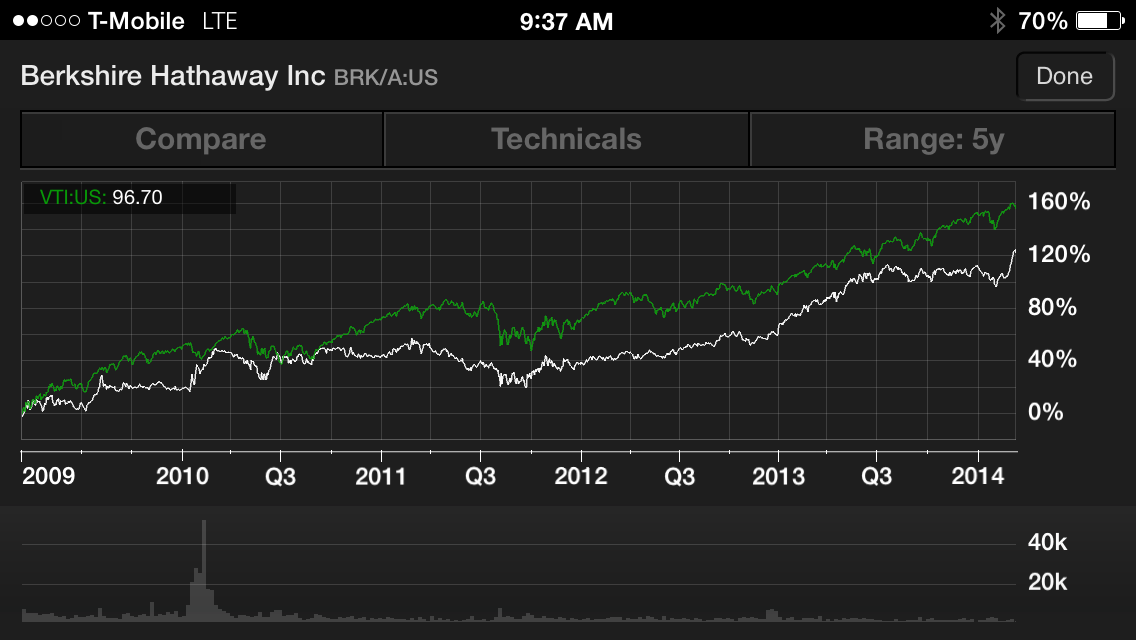
Regarding point #3, VTI has beaten BRK-A by 40% over the last five years. VTI is a simple total stock market index that does pay dividends. Companies in that index also repurchase stock. Here is a graph from my phone:

Yes, a longer time horizon and risk adjustment would complete the analysis, but you get my point: listen to one of the richest men in the world (Warren Buffett) but do not attempt to mimic his every move.

http://mobile.businessweek.com/news/2014-03-14/berkshire-opposes-shareholder-proposal-for-meaningful-dividend

Berkshire Opposes Shareholder Proposal for ‘Meaningful’ Dividend – Businessweek

Berkshire Opposes Shareholder Proposal for ‘Meaningful’ Dividend

By Zachary Tracer and Noah Buhayar
March 14, 2014 10:56 AM EDT

Warren Buffett’s Berkshire Hathaway Inc. (BRK/A) , which had $48.2 billion in cash as of Dec. 31, is urging shareholders to vote against a proposal for the board to consider paying a “meaningful” dividend.

The directors review annually whether to retain all of its earnings, and will follow previously stated principles about capital management, according to a proxy filing today from Omaha, Nebraska-based Berkshire. Buffett has said he can generate better returns for investors by pursuing takeovers, buying securities and investing in subsidiaries like MidAmerican Energy and the Burlington Northern Santa Fe Railroad.

Shareholder David Witt, who has a stake valued at about $8,650 based on yesterday’s closing price, proposed the measure, stating that Berkshire has “more money than it needs” and that the board should consider the investors who aren’t billionaires. Buffett, the chairman and chief executive officer, became the world’s second-richest person by building Berkshire over more than four decades.

“Our first priority with available funds will always be to examine whether they can be intelligently deployed in our various businesses,” Buffett, 83, wrote to shareholders in a letter last year. “Our shareholders are far wealthier today than they would be if the funds we used for acquisitions had instead been devoted to share repurchases or dividends.”

Berkshire’s board also urged shareholders to reject a proposal that it set goals for reducing greenhouse gas and other emissions by its energy businesses. The annual meeting is scheduled for May 3 in Omaha.

Buffett’s salary remained $100,000 and has been at that level for more than a quarter century, Berkshire said in the filing. His total compensation was listed at about $485,000, including the cost of personal and home security provided by the company. Vice Chairman Charles Munger, 90, also collects a $100,000 salary.

Munger has also said Berkshire pursued the right course by reinvesting funds rather than paying a dividend.

“I think that some of you will live to see a Berkshire dividend, but I hope I don’t,” Munger said in 2011.

To contact the reporters on this story: Zachary Tracer in New York at ztracer1; Noah Buhayar in New York at nbuhayar

To contact the editors responsible for this story: Dan Kraut at dkraut2 Steven Crabill

How Investors May Be Getting Fooled by Buybacks – ABC News

Buyback yield (BBY) is a prominent factor in JO screening. This 2014.03.11 article suggests that share repurchases can artificially inflate earnings per share. However, share repurchases are also a low-tax mechanism to return cash to shareholders (see my presentation on payout policy on efficientminds.com). Hence the prominence of BBY in JO’s shareholder yield calculation.

My take: be mindful of companies with high BBY. When you see high BBY also look at trends in CapEx and R&D. Ideally you would like to see the trends in CapEx and R&D similar pre and post any surge in share repurchases. That is, ensure the company is not sacrificing investment in itself just to transfer cash to shareholders.
http://abcnews.go.com/m/story?id=22864822&ref=http%3A%2F%2Fnews.google.com%2F

How Investors May Be Getting Fooled by Buybacks – ABC News

If you’re puzzled why the U.S. stock market has risen so fast in a slow-growing economy, consider one of its star performers: DirecTV.

The satellite TV provider has done a great job slashing expenses and expanding abroad, and that has helped lift its earnings per share dramatically in five years. But don’t be fooled. The main reason for the EPS gain has nothing to do with how well it runs its business. It’s because it has engaged in a massive stock buyback program, halving the number of its shares in circulation by purchasing them from investors.

Spreading earnings over fewer shares translates into higher EPS — a lot higher in DirecTV’s case. Instead of an 88 percent rise to $2.58, EPS nearly quadrupled to $5.22.

Companies have been spending big on buybacks since the 1990s. What’s new is the way buybacks have exaggerated the health of many companies, suggesting through EPS that they are much better at generating profits than they actually are. The distortion is ironic. Critics say the obsessive focus on buybacks has led companies to put off replacing plant and equipment, funding research and development, and generally doing the kind of spending needed to produce rising EPS for the long run.

“It’s boosted the stock market and flattered earnings, but it’s very short term,” says David Rosenberg, former chief economist at Merrill Lynch, now at money manager Gluskin Sheff. He calls buybacks a “sugar high.”

Over the past five years, 216 companies in the S&P 500 are just like DirecTV: They are getting more of a boost in EPS from slashing share count than from running their underlying business, according to a study by consultancy Fortuna Advisors at the request of The Associated Press. The list of companies cuts across industries, and includes retailer Gap, supermarket chain Kohl’s, railroad operator Norfolk Southern and drug distributor AmerisourceBergen.

The stocks of those four have more than tripled, on average, in the past five years.

Companies insist that their buybacks must be judged case by case.

“The vast majority of our shareholders are sophisticated investors who not only use EPS growth but other important measures to determine the success of our company,” says Darris Gringeri, a spokesman for DirecTV.

But Fortuna CEO Gregory Milano says buybacks are a waste of money for most companies.

“It’s game playing — a legitimate, legal form of manufacturing earnings growth,” says Milano, author of several studies on the impact of buybacks. “A lot of people (focus on) earnings per share growth, but they don’t adequately distinguish the quality of the earnings.”

So powerful is the impact, it has turned what would have been basically flat or falling EPS into a gain at some companies over five years. That list includes Lockheed Martin, the military contractor, Cintas, the country’s largest supplier of work uniforms, WellPoint, an insurer, and Dun and Bradstreet, a credit-rating firm.

It’s not clear investors are worried, or even aware, how much buybacks are exaggerating the underlying strength of companies. On Friday, they pushed the Standard and Poor’s 500 stock index to a record close, up 178 percent from a 12-year low in 2009.

“How much credit should a company get earning from share buybacks rather than organic growth?” asks Brian Rauscher, chief portfolio strategist at Robert W. Baird & Co, an investment company. “I think the quality of earnings has been much lower than what the headlines suggest.”

And it could get worse.

Companies in the S&P 500 have earmarked $1 trillion for buybacks over the next several years. That’s on top of $1.7 trillion they spent on them in the previous five years. The figure is staggering. It is enough money to cut a check worth $5,345 for every man, women and child in the country.

There is nothing necessarily nefarious or wrong about buybacks per se. It doesn’t seem that managements are trying to cover up a poor job of running their businesses. Even without factoring in a drop in share counts, earnings in the S&P 500 would have risen 80 percent since 2009.

The problem is that many investors are pouring money willy-nilly into companies doing buybacks as if they are always a good thing, and at every company.

A fund that tracks companies cutting shares the most, the PowerShares Buyback Achievers Portfolio, attracted $2.2 billion in new investments in the last 12 months. That is nine times what had been invested at the start of that period, according Lipper, which provides data on funds.

For their part, the companies note there are all sorts of reasons to like them besides EPS.

WellPoint points out that it has increased its cash dividend three times since 2011, a big draw for people looking for income. Cintas says that it’s timed its buybacks well, buying at a deep discount to stock price today. And DirecTV says investors judge it also by revenue and cash flow, both of which are up strongly.

What’s more, companies seem to genuinely believe their shares are a bargain and they’d be remiss for not buying, though their record of choosing the right time is poor.

The last time buybacks were running so high was 2007, right before stocks fell by more than half.

There are signs the next $1 trillion in buybacks for S&P 500 companies could also prove ill-timed. Stocks aren’t looking so cheap anymore. After a surge of nearly 30 percent last year, the S&P 500 is trading at 25 times its 10-year average earnings, as calculated by Nobel Prize winning economist Robert Shiller of Yale. That is much more expensive than the long-term average of 16.5.

Many investors assume shrinking shares automatically make remaining shares more valuable. The math is seductive. A company that has $100 in earnings and 100 shares will report $1 in earnings per share. But eliminate half the shares and the same $100 is spread over 50 shares, and EPS doubles to $2.

But that doesn’t make the shares more valuable.

Shares aren’t just a claim on short-term earnings. They are an ownership stake in an entire company, including R&D programs and its capital stock — the plants, equipment and other assets needed to boost productivity long into the future. Critics say the lavish spending on buybacks has “crowded out” spending on such things, which is at its weakest in decades.

“It’s just like your car depreciating or your home depreciating — you have to invest,” says Gluskin Sheff’s Rosenberg, “The corporate sector has barely preventing the capital stock from becoming obsolete.”

One result: U.S. productivity, or output per hour, increased just 0.5 percent last year, a pitiful performance. It has grown by an average 2 percent a year since 1947.

If not reversed, history suggests stocks will suffer. In a 2010 study, Fortuna’s Milano found that stocks of companies that spent the most on buybacks vastly underperformed stocks of those that spent the least on them — at least over five years.

It’s unclear whether the kind of investor who dominates stock trading now cares about the long-term, though. Buybacks are one of the few sure-fire ways to push a stock higher in the short term, and investors these days are very short term.

They “don’t care what happens in three or five years,” laments Rauscher, the Baird strategist. “The market has become less of an investor culture, more of a trading one.”

———

Follow Bernard Condon on Twitter at http://twitter.com/BernardFCondon.