Berkshire Opposes Shareholder Proposal for ‘Meaningful’ Dividend – Businessweek

My three cents:
1. Share repurchases are okay as long as you are not sacrificing investment in the company (R&D, upgrading equipment, etc.) and not attempting to manipulate EPS.
2. Dividend payments are okay as long as you are not sacrificing investment in the company.
3. Investing in the company is okay as long as you are not getting beat by an index.

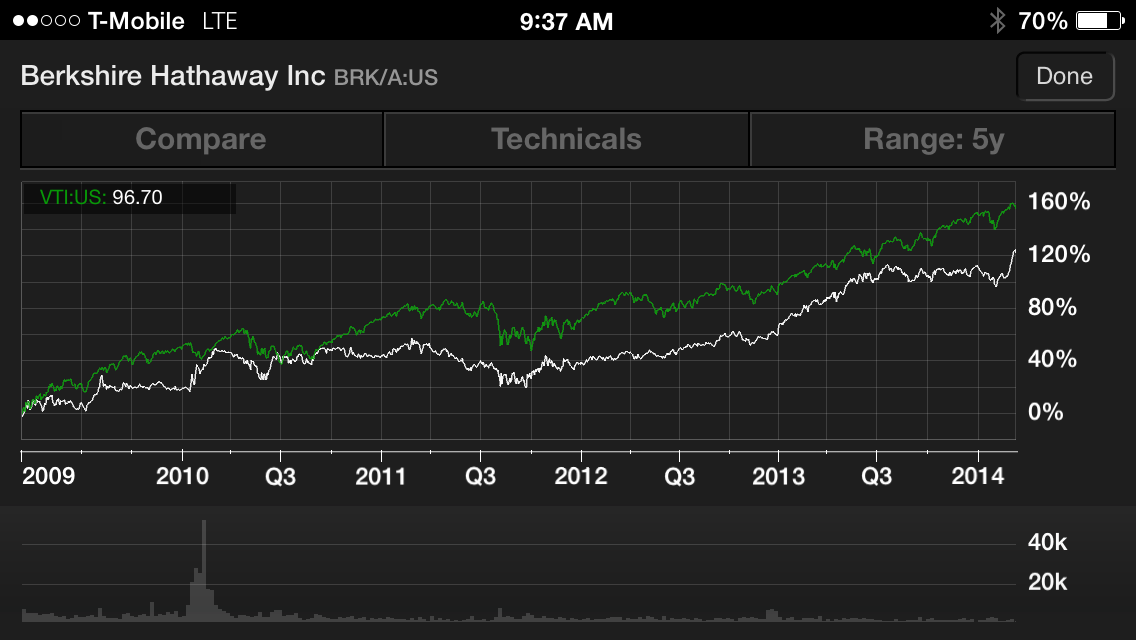
Regarding point #3, VTI has beaten BRK-A by 40% over the last five years. VTI is a simple total stock market index that does pay dividends. Companies in that index also repurchase stock. Here is a graph from my phone:

Yes, a longer time horizon and risk adjustment would complete the analysis, but you get my point: listen to one of the richest men in the world (Warren Buffett) but do not attempt to mimic his every move.

http://mobile.businessweek.com/news/2014-03-14/berkshire-opposes-shareholder-proposal-for-meaningful-dividend

Berkshire Opposes Shareholder Proposal for ‘Meaningful’ Dividend – Businessweek

Berkshire Opposes Shareholder Proposal for ‘Meaningful’ Dividend

By Zachary Tracer and Noah Buhayar
March 14, 2014 10:56 AM EDT

Warren Buffett’s Berkshire Hathaway Inc. (BRK/A) , which had $48.2 billion in cash as of Dec. 31, is urging shareholders to vote against a proposal for the board to consider paying a “meaningful” dividend.

The directors review annually whether to retain all of its earnings, and will follow previously stated principles about capital management, according to a proxy filing today from Omaha, Nebraska-based Berkshire. Buffett has said he can generate better returns for investors by pursuing takeovers, buying securities and investing in subsidiaries like MidAmerican Energy and the Burlington Northern Santa Fe Railroad.

Shareholder David Witt, who has a stake valued at about $8,650 based on yesterday’s closing price, proposed the measure, stating that Berkshire has “more money than it needs” and that the board should consider the investors who aren’t billionaires. Buffett, the chairman and chief executive officer, became the world’s second-richest person by building Berkshire over more than four decades.

“Our first priority with available funds will always be to examine whether they can be intelligently deployed in our various businesses,” Buffett, 83, wrote to shareholders in a letter last year. “Our shareholders are far wealthier today than they would be if the funds we used for acquisitions had instead been devoted to share repurchases or dividends.”

Berkshire’s board also urged shareholders to reject a proposal that it set goals for reducing greenhouse gas and other emissions by its energy businesses. The annual meeting is scheduled for May 3 in Omaha.

Buffett’s salary remained $100,000 and has been at that level for more than a quarter century, Berkshire said in the filing. His total compensation was listed at about $485,000, including the cost of personal and home security provided by the company. Vice Chairman Charles Munger, 90, also collects a $100,000 salary.

Munger has also said Berkshire pursued the right course by reinvesting funds rather than paying a dividend.

“I think that some of you will live to see a Berkshire dividend, but I hope I don’t,” Munger said in 2011.

To contact the reporters on this story: Zachary Tracer in New York at ztracer1; Noah Buhayar in New York at nbuhayar

To contact the editors responsible for this story: Dan Kraut at dkraut2 Steven Crabill

How Investors May Be Getting Fooled by Buybacks – ABC News

Buyback yield (BBY) is a prominent factor in JO screening. This 2014.03.11 article suggests that share repurchases can artificially inflate earnings per share. However, share repurchases are also a low-tax mechanism to return cash to shareholders (see my presentation on payout policy on efficientminds.com). Hence the prominence of BBY in JO’s shareholder yield calculation.

My take: be mindful of companies with high BBY. When you see high BBY also look at trends in CapEx and R&D. Ideally you would like to see the trends in CapEx and R&D similar pre and post any surge in share repurchases. That is, ensure the company is not sacrificing investment in itself just to transfer cash to shareholders.
http://abcnews.go.com/m/story?id=22864822&ref=http%3A%2F%2Fnews.google.com%2F

How Investors May Be Getting Fooled by Buybacks – ABC News

If you’re puzzled why the U.S. stock market has risen so fast in a slow-growing economy, consider one of its star performers: DirecTV.

The satellite TV provider has done a great job slashing expenses and expanding abroad, and that has helped lift its earnings per share dramatically in five years. But don’t be fooled. The main reason for the EPS gain has nothing to do with how well it runs its business. It’s because it has engaged in a massive stock buyback program, halving the number of its shares in circulation by purchasing them from investors.

Spreading earnings over fewer shares translates into higher EPS — a lot higher in DirecTV’s case. Instead of an 88 percent rise to $2.58, EPS nearly quadrupled to $5.22.

Companies have been spending big on buybacks since the 1990s. What’s new is the way buybacks have exaggerated the health of many companies, suggesting through EPS that they are much better at generating profits than they actually are. The distortion is ironic. Critics say the obsessive focus on buybacks has led companies to put off replacing plant and equipment, funding research and development, and generally doing the kind of spending needed to produce rising EPS for the long run.

“It’s boosted the stock market and flattered earnings, but it’s very short term,” says David Rosenberg, former chief economist at Merrill Lynch, now at money manager Gluskin Sheff. He calls buybacks a “sugar high.”

Over the past five years, 216 companies in the S&P 500 are just like DirecTV: They are getting more of a boost in EPS from slashing share count than from running their underlying business, according to a study by consultancy Fortuna Advisors at the request of The Associated Press. The list of companies cuts across industries, and includes retailer Gap, supermarket chain Kohl’s, railroad operator Norfolk Southern and drug distributor AmerisourceBergen.

The stocks of those four have more than tripled, on average, in the past five years.

Companies insist that their buybacks must be judged case by case.

“The vast majority of our shareholders are sophisticated investors who not only use EPS growth but other important measures to determine the success of our company,” says Darris Gringeri, a spokesman for DirecTV.

But Fortuna CEO Gregory Milano says buybacks are a waste of money for most companies.

“It’s game playing — a legitimate, legal form of manufacturing earnings growth,” says Milano, author of several studies on the impact of buybacks. “A lot of people (focus on) earnings per share growth, but they don’t adequately distinguish the quality of the earnings.”

So powerful is the impact, it has turned what would have been basically flat or falling EPS into a gain at some companies over five years. That list includes Lockheed Martin, the military contractor, Cintas, the country’s largest supplier of work uniforms, WellPoint, an insurer, and Dun and Bradstreet, a credit-rating firm.

It’s not clear investors are worried, or even aware, how much buybacks are exaggerating the underlying strength of companies. On Friday, they pushed the Standard and Poor’s 500 stock index to a record close, up 178 percent from a 12-year low in 2009.

“How much credit should a company get earning from share buybacks rather than organic growth?” asks Brian Rauscher, chief portfolio strategist at Robert W. Baird & Co, an investment company. “I think the quality of earnings has been much lower than what the headlines suggest.”

And it could get worse.

Companies in the S&P 500 have earmarked $1 trillion for buybacks over the next several years. That’s on top of $1.7 trillion they spent on them in the previous five years. The figure is staggering. It is enough money to cut a check worth $5,345 for every man, women and child in the country.

There is nothing necessarily nefarious or wrong about buybacks per se. It doesn’t seem that managements are trying to cover up a poor job of running their businesses. Even without factoring in a drop in share counts, earnings in the S&P 500 would have risen 80 percent since 2009.

The problem is that many investors are pouring money willy-nilly into companies doing buybacks as if they are always a good thing, and at every company.

A fund that tracks companies cutting shares the most, the PowerShares Buyback Achievers Portfolio, attracted $2.2 billion in new investments in the last 12 months. That is nine times what had been invested at the start of that period, according Lipper, which provides data on funds.

For their part, the companies note there are all sorts of reasons to like them besides EPS.

WellPoint points out that it has increased its cash dividend three times since 2011, a big draw for people looking for income. Cintas says that it’s timed its buybacks well, buying at a deep discount to stock price today. And DirecTV says investors judge it also by revenue and cash flow, both of which are up strongly.

What’s more, companies seem to genuinely believe their shares are a bargain and they’d be remiss for not buying, though their record of choosing the right time is poor.

The last time buybacks were running so high was 2007, right before stocks fell by more than half.

There are signs the next $1 trillion in buybacks for S&P 500 companies could also prove ill-timed. Stocks aren’t looking so cheap anymore. After a surge of nearly 30 percent last year, the S&P 500 is trading at 25 times its 10-year average earnings, as calculated by Nobel Prize winning economist Robert Shiller of Yale. That is much more expensive than the long-term average of 16.5.

Many investors assume shrinking shares automatically make remaining shares more valuable. The math is seductive. A company that has $100 in earnings and 100 shares will report $1 in earnings per share. But eliminate half the shares and the same $100 is spread over 50 shares, and EPS doubles to $2.

But that doesn’t make the shares more valuable.

Shares aren’t just a claim on short-term earnings. They are an ownership stake in an entire company, including R&D programs and its capital stock — the plants, equipment and other assets needed to boost productivity long into the future. Critics say the lavish spending on buybacks has “crowded out” spending on such things, which is at its weakest in decades.

“It’s just like your car depreciating or your home depreciating — you have to invest,” says Gluskin Sheff’s Rosenberg, “The corporate sector has barely preventing the capital stock from becoming obsolete.”

One result: U.S. productivity, or output per hour, increased just 0.5 percent last year, a pitiful performance. It has grown by an average 2 percent a year since 1947.

If not reversed, history suggests stocks will suffer. In a 2010 study, Fortuna’s Milano found that stocks of companies that spent the most on buybacks vastly underperformed stocks of those that spent the least on them — at least over five years.

It’s unclear whether the kind of investor who dominates stock trading now cares about the long-term, though. Buybacks are one of the few sure-fire ways to push a stock higher in the short term, and investors these days are very short term.

They “don’t care what happens in three or five years,” laments Rauscher, the Baird strategist. “The market has become less of an investor culture, more of a trading one.”

———

Follow Bernard Condon on Twitter at http://twitter.com/BernardFCondon.

Lessons From the Bull Market – WSJ.com

I really like the example of two paths to the same summit of $500,000 in savings:

Path 1. Rely more on the stock market with a larger allocation to stocks and $5,000/year savings

Path 2. Rely less on the market with a smaller allocation to stocks and increasing your savings of $5,000/year by 10% each year.

Path 1 is an ordinary annuity problem. Path 2 is a growing ordinary annuity problem. Verification of these numbers will make an excellent extra credit assignment for my students… 🙂 (solution available on my OneDrive).

Nevertheless, I highly recommend reading this article for perspective on investing in today’s environment. I also like how the article validates what I frequently say in class: the long run average P/E for stocks is 16.5. The average of VTI is 18.1 (http://money.cnn.com/quote/etf/etf.html?symb=VTI). A little high but better than the 25 number mentioned in the article. So, be mindful of P/E.

Enjoy the article…

http://m.us.wsj.com/articles/SB10001424052702304732804579423350714558572?mg=reno64-wsj

Lessons From the Bull Market

Do you remember how you felt about the stock market on March 9, 2009?

Evidence suggests many investors have blocked out those fearful times. Five years after the S&P 500 hit its lowest point during the financial crisis, investors are pouring money into stocks.

In 2013, investors put $172 billion into U.S. stock mutual funds and exchange-traded funds, more than they had withdrawn from 2008 to 2012 combined, according to Lipper, which tracks funds. They have added another $24 billion in 2014, through Wednesday.

A little complacency is understandable. If you took a Rip Van Winkle nap starting in 2007 and woke up this weekend, you might conclude nothing bad had happened. The S&P 500 has shot up to record levels and hit another all-time peak on Friday. The index is up 178% over the past five years, not including dividends.

If you stuck with stocks throughout, your reward would be huge: An investor who wagered $100,000 on the index on March 9, 2009, would have $308,127, including dividends, as of Wednesday, according to Chicago-based investment-research firm Morningstar.

But the financial crisis was real, and so was the steep plunge it triggered in the stock market. “People watched their money get cut in half, if not more,” says Peter Tuchman, a floor broker at the New York Stock Exchange for Quattro M. Securities. “That was such a wake-up call.”

Instead of sweeping those memories aside, investors need to reflect honestly about what that bear market meant, how it affected their behavior then and how it ought to factor into their thinking now.

Above all, investors would be wise to avoid betting on anything that looks like a prediction. Instead, they should prepare for the future with a few strategies whose enduring value has been underscored by the events of the past five years.

Be Skeptical of Experts

Every day, in the newspapers, on financial-news shows and online, dozens of market strategists make bold predictions about the direction stocks are heading.

Take their forecasts with a mound of salt.

After all, current prices already reflect the sum of stock-market buyers’ and sellers’ opinions. If one investor is bullish, there must be another investor on the other side at the current price, notes Philip Tetlock, a professor of management at the University of Pennsylvania’s Wharton School.

Forecasts get better as more experts’ opinions are brought in, says Mr. Tetlock, who is currently running a forecasting tournament in which anyone can participate at GoodJudgmentProject.com.

In a March 2, 2009, Wall Street Journal article, for example, Wilmington, Del.-based financial adviser Judith Lau said that for many months she had built up clients’ allocations to bonds and cash and that she thought it could take 18 months or longer for stocks to pick up again. In fact, stocks would be up sharply by the end of 2009.

She wasn’t alone, of course. The Journal in early 2009 quoted more than a dozen strategists, financial planners and money managers who said they expected things to get worse before they got better.

“In hindsight, we would have put everything we had in the market on March 2 and told our clients to hang on. We would have lost a third of them, but they would have made a gazillion dollars and would have been happy,” Ms. Lau, whose firm oversees about $600 million, says now. “But you don’t have the benefit of hindsight.”

The lesson: Take expert predictions lightly, and if you act on them, make small moves rather than drastic ones. Even though she thought stocks would continue to suffer, Ms. Lau in the 2009 article recommended a portfolio that was half in stocks.

And a corollary: An expert who was once “right” won’t necessarily be correct again the next time. In choosing which experts to listen to, pick ones who seem aware of the uncertainty of their predictions and are willing to change their minds, says Prof. Tetlock.

Remember What Losing Felt Like

In a speech about intellectual honesty 40 years ago, Nobel Prize-winning physicist Richard Feynman said, “The first principle is that you must not fool yourself—and you are the easiest person to fool.”

Many investors appear to be kidding themselves. Financial advisers report that some clients appear to be forgetting the intense fear they felt five years ago.

With U.S. stocks up more than 32% last year, many are asking why their personal accounts were up less than 20%.

In 2009, the pain of further losses on stocks was too great for some investors to bear; now, it is the pain of not holding more stocks that bothers them. “Memory has done a kind of 180-degree turn for some people,” says Owen Murray, a partner at Horizon Advisors, a financial-planning and investment-management firm in Houston that oversees about $230 million.

Some clients are asking, “Why haven’t we been more aggressive?” even though they were the ones who insisted on making their portfolios more conservative in the wake of the crisis, says Daniel Roe, chief investment officer at Budros, Ruhlin & Roe, a financial adviser in Columbus, Ohio, which manages about $1.7 billion.

What they should be asking is this: Am I fooling myself into remembering my losses as less painful than they were? Am I itching to take risks that my own history should warn me I will end up regretting? Am I counting on willpower alone to enable me to stay invested and to rebalance through another crash?

For the answers, dig up your old account statements to see whether you held fast in late 2008 and early 2009. Ask your spouse or a close friend how anxious or afraid you were during the crisis. Then ask yourself whether you want to repeat that experience.

If your records show that you bought or stayed put during the last crisis, then you can probably weather the next one—and should stay put now. But if you sold then, you almost certainly will sell again if the markets take another steep fall. In that case, you should consider using the recent market gains as a gift that enables you to take some risk off the table before it can hurt you again.

Limit Your Risk-Taking

Owning some stock is a good thing for many investors. Over long periods, stocks tend to outperform bonds by a few percentage points annually, giving a powerful boost to portfolios. Investors who dumped their stocks have missed out on that benefit over the past few years.

Instead of periodically bailing on stocks, investors would be better off keeping a smaller amount in stocks and sticking with that allocation in good times and bad, says David Allison, a vice president at Allison Investment Management in Wrightsville Beach, N.C., which oversees about $70 million.

Alternatively, investors can pare back their stock allocation if they’re willing to step up their savings rate to compensate, says Chris Philips, a senior analyst at Vanguard Group.

Take an investor who starts contributing $5,000 a year to a brokerage account. If he put his entire portfolio in stocks, and stocks went on to return 8% annually, he would have $500,000 after about 26 years, according to an analysis by Mr. Philips.

If the same investor drastically cut his stock allocation, reducing his expected return to 4%—but increased his retirement-account contribution by 10% every year to compensate—he would hit $500,000 after only 22 years.

“You don’t have to rely so much on the market to get you where you want, but if you want to rely less, you have to be willing to increase those savings,” he says.

Be Wary of Labels

Investors who hear the phrase “bull market” might decide it is time to get in on the rally. On the other hand, investors who hear the current bull market in stocks has been running for five years might worry it will soon end. In either case, investors would do better to tune out the chatter. The definition of a bull market is arbitrary, and the term tells investors little about what will happen next.

The Wall Street Journal and many other market watchers call it a bull market when stocks rise 20% off a low point, and a bear market when they fall 20% from a peak. But investors who use slightly lower thresholds would see a more volatile picture of how stocks have behaved in recent years.

Plug in 15%, for instance, and suddenly there have been two bear markets since March 9, 2009, according to data from FactSet. Even using 19% would result in a bull market that lasted until April 29, 2011, followed by a bear market that endured for more than five months, and then the current bull market.

In fact, that 2011 drop almost qualified as a bear market under the widely accepted definition. Stocks fell early in the trading day on Oct. 4, 2011, and at one point the S&P 500 was down 21% from its April peak. But stocks rallied that afternoon, and the narrative of a five-year bull market survived.

The small sample size is another issue. There have been only 11 bull markets—using 20% as the yardstick—since the start of 1957, the year the S&P 500 was introduced in its current form, according to FactSet. Using past data to try to gauge how long a bull market will last is tricky because of the huge range—the longest one since 1957 lasted 3,109 trading days, the shortest just 30.

Taking an average could just exacerbate the problem. “That’s where a lot of people go wrong,” says Laszlo Birinyi, president of Birinyi Associates, an investment-research firm in Westport, Conn. “There is no such thing as an average bull market.”

Investors would be better off focusing on whether stocks are valued more highly than in the past. By that standard, stocks warrant more caution today than five years ago.

In March 2009, stocks traded at about 13 times their average earnings over the prior 10 years, adjusted for inflation, according to Nobel Prize-winning economist Robert Shiller of Yale University. Now, stocks are trading at about 25 times average earnings. The historical average is 16.5.

Terms like bull market and bear market are eye-catching labels—not forecasts.

Question Performance Figures

It is one of the most oft-repeated adages in investing: Past performance doesn’t guarantee future results. In fact, it can be a poor guide to past results, too.

Many mutual funds and investment advisers promote themselves based on their average annual performance over the prior five years. As of the end of February, their returns suddenly looked a lot better—not because the managers have gotten smarter or cut fees, but because of luck.

That’s because the five-year period now begins in March 2009—a month in which U.S. stocks returned 9% as the financial crisis began to wane. By contrast, stocks lost nearly 11% in February 2009; that bloodbath has just dropped out of the five-year return sequence.

According to Morningstar, the five-year average annual returns of more than 40 mutual funds improved by at least seven percentage points when the pages of the calendar flipped from February to March.

Real-estate funds were the most common beneficiaries, with their long-term returns shooting up largely due to the disappearance of a single month. On March 1, the five-year average annual return for the Franklin Real Estate Securities Fund went to 26.8% from 19.7%; for the Columbia Real Estate Equity Fund, to 26% from 19.4%; for the Fidelity Real Estate Investment Portfolio, to 30.8% from 23.1%.

In February 2009, real-estate investment trusts lost 20.8%, as measured by the FTSE NAREIT All Equity REITs index.

February 2009 has just been replaced by March 2009, when REITs gained 4.1%. So the five-year returns on real-estate stocks have gotten a huge boost that might make them sound almost irresistible.

REITs can be useful in diversifying the risks of stocks and bonds. But they are risky, too. The many financial advisers touting REITs as “bond alternatives” have no incentive to call attention to the carnage of February 2009. But that 20.8% loss wasn’t imaginary.

If the past is any guide, financial advisers will tout the suddenly higher returns of their funds, and money will pile in. Research by finance professor Raghavendra Rau of the University of Cambridge and his colleagues has shown that investors flock to funds whose five-year returns improve when a bad month drops out of the beginning of the sequence.

Fund companies, according to the research, advertise more and even raise their fees to take advantage of the “improved” performance.

Whenever anyone tells you about an investment’s five-year returns, remember to ask what those returns looked like at the end of 2013—or, even better, in March 2009. They might suddenly sound a lot less appealing.

Write to Jason Zweig at intelligentinvestor, Joe Light at joe.light and Liam Pleven at liam.pleven

Energy sector’s newest power player: Elon Musk | LinkedIn

A home or business with solar panels, battery storage, and connection to the electrical grid could be both a producer and consumer of energy. A very neat idea. Maybe we could connect treadmills to our home “grid” and simultaneously get cardio and store electricity for future use or sale…

https://www.linkedin.com/today/post/article/20140302203055-127714-energy-sector-s-newest-power-player-elon-musk?trk=eml-ced-b-art-M-1&midToken=AQH426MKGSWS3g&ut=2noNuOgJPFuC81&_mSplash=1

LA Times – Apple’s Tim Cook gets feisty, funny and fiery at shareholders meeting

Interesting shareholder meeting. Tim Cook states
• Martin Luther King and Bobby Kennedy are his heroes
• Apple cares about human rights
• is active in philanthropy
• not concerned about making big purchases to catch headlines • chooses doing the right thing over ROI

Pretty strong claims. How do we verify the truthfulness, in particular the ROI claim? Hoarding cash in overseas accounts? Is that the right thing? Accumulating that cash by employing slave labor in china at the expense of jobs here in the US? Is that the right thing?

I don’t claim to have answers but I do have questions…

http://touch.latimes.com/#tribMenu

Banking: Best online bank, checking or borrowing alternatives – Jan. 13, 2012

An old article but still interesting. I use a credit union (SAFE) / Brokerage (Scottrade) combo myself and recommend it (actually vanguard if you have $3k to play with). I use the credit union for checking, bill payment, car loan, and the cash (CD) portion of long term savings. I use the brokerage account strictly for equity investments.

I just recommended Vanguard to a client for brokerage services. Why? First, commission free trading of vanguard ETFs. This will come in handy as I refine my sector ETF approach that requires more frequent transactions. Vanguard has some of the lowest, if not the lowest, sector index ETF expense ratios and a wide range of sectors to choose from.

The second reason is that ETFs are more flexible than mutual funds in the event you need access to your money. Mutual funds tend to have early redemption fees if you sell within 90 days. ETFs do not.

So, I like Vanguard for commission free trading of a wide range of low expense ratio index ETFs. Schwab, e-trade, and scottrade could also work but you will have to find alternatives to Vanguard ETFs for commission free trading. In particular, finding a wide range of low expense ratio commission free sector ETFs is difficult at non-Vanguard brokerages.

Happy investing everyone…

http://money.cnn.com/2012/01/13/pf/online_banking.moneymag/

Facebook buying messaging app WhatsApp for $19B – The Washington Post

A staggering amount. An app company with only 55 people going for $19 billion dollars? More than Motorola mobility’s sale to Google for $12.5B? 19 times larger than any acquisition that Apple has ever done? I just don’t get it.

Most of the $19B ($12B) was paid for with “Facebook cash,” I.e., Facebook shares. This reminds me of the dot com boom days. During that time Cisco would print money, I mean issue shares, to purchase smaller companies.

We need to start a 55 person company and sell it for a discount price of $15 billion…

http://m.washingtonpost.com/business/facebook-buying-messaging-app-whatsapp-for-19b/2014/02/19/a93a3d18-99ca-11e3-b1de-e666d78c3937_story.html

Facebook buying messaging app WhatsApp for $19B

NEW YORK — Facebook is buying mobile messaging service WhatsApp for $19 billion in cash and stock, by far the company’s largest acquisition and bigger than any that Google, Microsoft or Apple have ever done.

The world’s biggest social networking company said Wednesday that it is paying $12 billion in Facebook stock and $4 billion in cash for WhatsApp. In addition, the app’s founders and employees — 55 in all — will be granted restricted stock worth $3 billion that will vest over four years after the deal closes.

The deal translates to roughly 11 percent of Facebook’s market value. In comparison, Google’s biggest deal, Motorola Mobility, stood at $12.5 billion, while Microsoft’s largest was Skype at $8.5 billion. Apple, meanwhile, has never done a deal above $1 billion.

The price stunned Gartner analyst Brian Blau. “I am not surprised they went after WhatsApp, but the amount is staggering,” he said.

Facebook likely prizes WhatsApp for its audience of teenagers and young adults who are increasingly using the service to engage in online conversations outside of Facebook, which has evolved into a more mainstream hangout inhabited by their parents, grandparents and even their bosses at work.

WhatsApp also has a broad global audience. Facebook CEO Mark Zuckerberg said the service “doesn’t get as much attention in the U.S. as it deserves because its community started off growing in Europe, India and Latin America. But WhatsApp is a very important and valuable worldwide communication network. In fact, WhatsApp is the only widely used app we’ve ever seen that has more engagement and a higher percent of people using it daily than Facebook itself.”

Blau said Facebook’s purchase is a bet on the future. “They know they have to expand their business lines. WhatsApp is in the business of collecting people’s conversations, so Facebook is going to get some great data,” he noted.

In that sense, the acquisition makes sense for 10-year-old Facebook as it looks to attract its next billion users while keeping its existing 1.23 billion members, including teenagers, interested. The company is developing a “multi-app” strategy, creating its own applications that exist outside of Facebook and acquiring others. It released a news reader app called Paper earlier this month, and has its own messaging app called Facebook Messenger.

“Facebook seems to be in acknowledgement that people are using a lot of different apps to communicate,” said eMarketer analyst Debra Aho Williamson. “In order to continue to reach audiences, younger in particular, it needs to have a broader strategy…not put all its eggs in one basket.”

Facebook said it is keeping WhatsApp as a separate service, just as it did with Instagram, which it bought for about $715.3 million in two years ago.

WhatsApp has more than 450 million monthly active users. In comparison, Twitter had 241 million users at the end of 2013. At $19 billion, Facebook is paying $42 per WhatsApp user in the deal.

The deal is likely to raise worries that Facebook and other technology companies are becoming overzealous in their pursuit of promising products and services, said Anthony Michael Sabino, a St. John’s University business professor.

“This could be seen as a microcosm of a bubble,” Sabino said. “I expect there to be a lot of skepticism about this deal. People are going to look at this and say, ‘Uh, oh, did they pay way too much for this?”

For Facebook, WhatsApp’s huge user base, fast growth pace and popularity is worth the money. The app is currently adding a million new users a day. At this rate, said Zuckerberg, WhatsApp is on path to reach a billion users. He called services that reach this milestone “incredibly valuable.” It’s an elite group to be sure — one that includes Google (which owns YouTube), Facebook itself and little else.

“We want to provide the best tools to share with different sized groups and in different contexts and to develop more mobile experiences beyond just the main Facebook app, like Instagram and Messenger,” Zuckerberg said in a conference call. “This is where we see a lot of new growth as well as a great opportunity to better serve our whole community.”

WhatsApp, a messaging service for smartphones, lets users chat with their phone contacts, both one-on-one and in groups. The service allows people to send texts, photos, videos and voice recordings over the Internet. It also lets users communicate with people overseas without incurring charges for pricey international texts and phone calls. It costs $1 per year and has no ads.

“It’ll be tempting to read this as a sign Facebook is scared of losing teens,” said Forrester analyst Nate Elliot in an emailed note. “And yes, the company does have to work hard to keep young users engaged. But the reality is, Facebook always works hard to keep all its users engaged, no matter their age. Facebook is tireless in its efforts to keep users coming back.”

Asked about the demographics of WhatsApp’s users, Facebook finance chief David Ebersman said that, “if you look at the kind of penetration that WhatsApp has achieved, it sort of goes without saying that they have good penetration across all demographics, we would imagine.

That said, “it’s not a service that asks you to tell them your age when you sign up,” he added.

The deal is expected to close later this year.

Shares of Menlo Park, Calif.-based Facebook fell $1.69 to $66.37 in extended trading after the deal was announced. The stock hit an all-time high of $69.08 earlier in the day.

__

AP Technology Writer Michael Liedtke in San Francisco and AP Business Writer Tali Arbel in New York contributed to this story.

Copyright 2014 The Associated Press. All rights reserved. This material may not be published, broadcast, rewritten or redistributed.